春季促销!结账时享七折优惠


Ancient Dzi Shop
Ancient Carnelian Longevity Motif Bead — 24.4 mm, Bloodspots, Medicine Dig, 1000–1500 Years (AC-101026-CM2)
Ancient Carnelian Longevity Motif Bead — 24.4 mm, Bloodspots, Medicine Dig, 1000–1500 Years (AC-101026-CM2)
We never retouch our photos. What you see is exactly what you will receive.
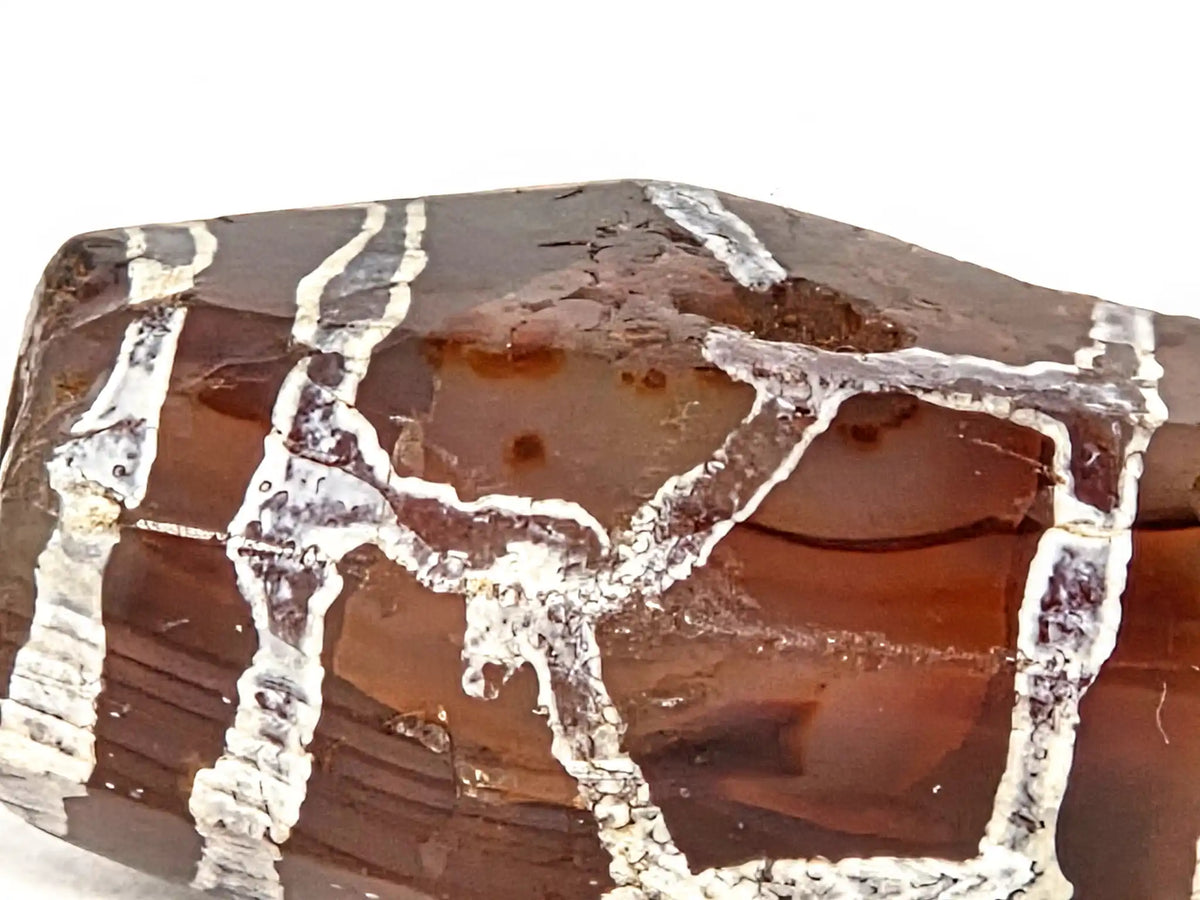
Three things distinguish this bead from every other etched carnelian in this collection. First: its age. At an estimated 1,000 to 1,500 years old, it predates the companion carnelian pieces in this collection by several centuries — reaching back to the early medieval period of the Central Asian trade routes, when the alkaline-etching tradition was at or near its peak of production and distribution. Second: its medicine digs. Two deliberate excavations into the bead surface — not damage, not wear, but intentional acts — have been made at some point in the bead's life, the excavated zones now worn smooth at their edges and filled with aged mineral deposits, their interiors as old as the bead itself. Third: its bloodspots. Warm rust-brown cinnabar deposits are distributed through the carnelian ground, visible in the macro photographs alongside and within the etching — the same iron-oxide mineral character seen in ancient dzi beads of comparable age, here present in the carnelian substrate.
The form is a wide, compact octagonal prism — eight flat faces, sharp facet edges, a pronounced squat profile at 24.4 mm long and 16.6 mm wide. This is the widest and most substantial of the three etched carnelian pieces in this collection, and its proportions place it in a distinct format category: broad, dense, and heavy in the hand for its length. The carnelian is exceptionally dark — a deep reddish-brown shifting toward purple-brown in the denser zones, with warm orange-red visible at the drill hole interiors where the stone's translucency asserts itself. The surface has developed the micro-pitted, finely textured character of carnelian that has been handled, buried, and re-handled over ten or more centuries.
The motif is a tortoise shell longevity pattern — the hexagonal or geometric panel network derived from the carapace of the tortoise, one of the oldest longevity symbols in Chinese and Central Asian decorative tradition, here translated into the alkaline-etching vocabulary of the ancient bead tradition. The white etching on this bead has advanced to the most extreme state of mineralisation in this collection: the alkaline compound has not merely mineralised into a thick deposit but has in places spread beyond all original line boundaries, blooming across the ground zones and merging between adjacent motif elements, so that the distinction between etched line and open carnelian ground becomes a matter of archaeological reading rather than visual clarity. At extreme macro the deposit shows multiple layers — crystalline, crumbling at its outer edges, metallic in its reflectivity — the physical accumulation of ten or more centuries of mineral transformation.
The two medicine digs are located on separate faces, each a distinct excavation into the carnelian body. Their edges are smooth and worn — not freshly cut, but aged in place, their interiors showing the same mineral character as the surrounding surface. Medicine digs on ancient etched carnelian beads are documented across multiple Central and South Asian archaeological contexts: the bead was understood to hold curative or protective power within the stone itself, and the excavated material — carnelian powder mixed with the etching compound — was used in medicinal or ritual preparations. A bead that has been medicine-dug is a bead that was considered too valuable to discard and too powerful to leave unused.
The Tortoise Shell Longevity Motif & Etched Carnelian
The tortoise shell motif — 龜甲紋 (guījiǎ wén) — is among the most ancient longevity symbols in East and Central Asian decorative tradition. The tortoise is one of the Four Divine Beasts of Chinese cosmology, associated with the north, with water, and above all with long life: the tortoise's carapace, with its geometric hexagonal network, became a symbol of structured longevity — not merely long life, but life ordered, protected, and enduring across time. On a bead of this age, carrying this motif, the intention is unambiguous: this object was made to be worn close to the body, to be handled across decades and generations, and to transmit its longevity symbolism directly to whoever carried it.
Specifications
Motif: Tortoise shell longevity (龜甲紋) — geometric hexagonal panel network across all octagonal faces; extreme mineralised white alkaline etching; motif boundaries partially obscured by advanced mineralisation
Length: 24.4 mm
Width: 16.6 mm
Form: Wide compact octagonal prism — eight flat faces, sharp facet edges
Material: Natural carnelian
Color: Deep reddish-brown to purple-brown carnelian; warm orange-red at drill interiors; extreme white-silver mineralised etching
Age Estimate: Ancient — 1,000–1,500 years
Condition: Excellent for age. Etching at extreme mineralisation — consistent with 1,000+ year antiquity. Two medicine digs with aged smooth edges. No structural cracks. Small original drill holes at both ends.
Bloodspots: Yes — warm rust-brown iron-oxide deposits distributed through the carnelian ground; visible in macro photographs
Medicine Digs: Two — on separate faces; edges worn smooth; interiors aged in place
Product ID: (AC-101026-CM2)
Collections: Ancient Dzi · All Products
Related etched carnelian pieces in the collection:
- AC-101026-CL6 — Ancient Etched Carnelian Six Cross & Longevity Motif, 27 mm, Tapered Octagon
- AC-100126-CM8 — Ancient Etched Carnelian Eight-Cross Bead, 22.9 mm, Four-Sided Beveled
Further reading: Where Do Dzi Beads Come From? Origin, History & Mystery · Dzi Motifs and Their Interpretations
Every piece at Ancient Dzi Shop is photographed unretouched and described exactly as found. What you see is what you will receive.
Photos: Unretouched images of the exact bead listed. Nine product photographs: five white-background lateral views covering all octagonal faces, two angled views showing both drill ends and the octagonal form, and two extreme macro close-ups documenting the mineralised etching surface and medicine dig detail.
#ancientdzi #etchedcarnelian #carnelianbeads #ancientbeads #tortoiseshell #longevitymotif #龜甲紋 #medicinedig #bloodspotcarnelian #centralasianbeads #tibetanbeads #antiquecarnelian #ancientjewelry #dzicollector #beadcollector
无法加载取货服务可用情况