サマーセール開催中!会計時に30%OFF!


Ancient Dzi Shop
Ancient Round Agate Bead — Stars Motif 22.3 mm 1500–2000 Years (AC-101126-RS)
Ancient Round Agate Bead — Stars Motif 22.3 mm 1500–2000 Years (AC-101126-RS)
We never retouch our photos. What you see is exactly what you will receive.
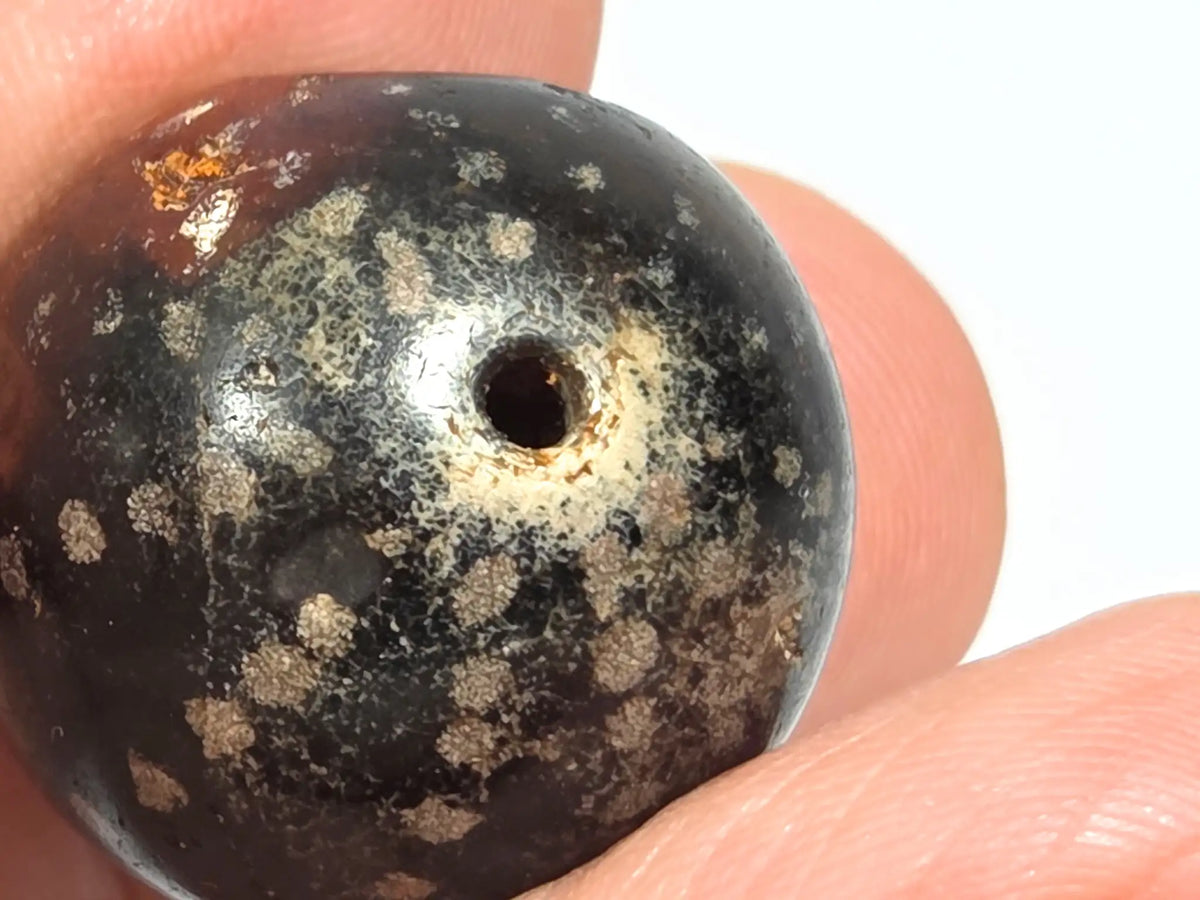
This bead is a near-perfect sphere — 22.3 mm across its long axis, 21.5 mm across its short axis — a round form that was relatively uncommon in the ancient bead-making traditions of the Himalayan world, where the elongated barrel was the predominant shape. Achieving a round form requires more material removal and more sustained polishing effort than a barrel, which is part of why round agate beads of this age are encountered less often than their cylindrical counterparts. The drilling passes through the full diameter, entering and exiting at the two poles of the sphere.
The agate itself is the primary visual material of this bead. The upper hemisphere and equatorial band are a deep dark brown, close to near-black in strong light, with the kind of visual depth that comes from agate formed under geological pressure over a long period. The lower hemisphere shifts into a warmer reddish-brown zone — a natural variation in mineral density within the same stone, not a surface treatment or separate material. This two-tone character is inherent to the agate and gives the bead a visual complexity that changes as it rotates. The surface carries a smooth, unified polish built up over centuries of handling: neither glassy nor matte, but the particular settled texture of an ancient stone that has been worn continuously for a very long time.
Scattered across the surface are small cream-to-silver-grey inclusions — mineral deposits within the stone body that sit flush with or just at the surface, catching light differently from the surrounding agate. There are perhaps fifteen to twenty visible across the full surface, distributed without pattern across both hemispheres and the equatorial zone. These are natural mica or calcite flecks fixed in the stone when the agate formed — not applied, not etched, not a later addition. Their scattered arrangement across the dark ground creates an effect that reads as a star field: points of light distributed across a dark surface, which is the basis of the "stars motif" designation for this bead type. The individual inclusions vary in size from under a millimeter to approximately two millimeters at their largest.
There are two condition notes that must be stated clearly. The first is a natural dimple — a shallow pit or depression in the agate surface, visible in the macro photographs and located in the equatorial zone of the bead. This is a natural void in the stone rather than a chip or impact damage: the edges of the depression are smooth and continuous with the surrounding surface, indicating it formed during the agate's geological development rather than from post-formation breakage. It is not a crack; it does not extend into the stone body; it does not affect the structural integrity of the bead. It is, however, a visible irregularity in the surface, and the macro photographs show it clearly. The second condition note is calcification at both drill ends: a cream-tan to cream-grey mineral deposit has built up around both drill hole apertures over the centuries of burial or storage. The deposit is more extensive at the darker hemisphere end, where calcification spreads broadly across the pole face surrounding the aperture; the warmer-toned hemisphere end shows a more contained ring of calcification immediately around the drill hole. This is a common feature of very old drilled beads that have spent extended periods in soil or mineral-rich environments, and it is part of the authentic patina of a piece of this age. It does not affect the drill hole's functionality for stringing.
The Stars Motif
Round agate beads with natural mineral inclusions that read as stars are a specific category within the ancient Himalayan bead tradition, distinct from beads with etched or applied motifs. The "motif" in this case is entirely geological — the bead was selected and preserved precisely because its natural inclusions were recognized as meaningful by the person who first strung it. The association of scattered mineral spots with stars and celestial bodies is universal: a dark surface with scattered points of light maps directly onto the night sky, and a bead that carries that visual within its own stone was understood as carrying something of celestial energy within it. In the Tibetan and Himalayan traditions, natural stone formations of this kind — inclusions, patterns, and internal structures that emerged without human intervention — were often regarded as signs of the stone's inherent spiritual character rather than as defects to be worked around.
Specifications
Motif: Stars — natural mineral inclusions (mica or calcite flecks), cream to silver-grey, scattered across full surface; fifteen to twenty inclusions distributed across both hemispheres and equatorial zone; no etching
Length: 22.3 mm
Diameter: 21.5 mm
Form: Near-spherical round
Material: Natural agate
Color: Deep dark brown upper hemisphere; warm reddish-brown lower hemisphere; cream-silver mineral inclusions
Age Estimate: Ancient — 1500–2000 years
Condition: Good overall. Natural dimple depression visible in macro photographs — smooth-edged, geological in origin, not a chip or crack. Calcification at both drill hole apertures: extensive cream-grey deposit spreading across the darker hemisphere pole; more contained ring deposit at the warmer hemisphere end. No structural cracks. Both drill holes functional.
Bloodspots: None
Product ID: AC-101126-RS
Collections: Ancient Dzi · All Products
Other ancient agate beads in the collection:
- AC-B-092526-9E — Ancient Tibetan Nine-Eye Dzi Bead with Bloodspot Patina, 45.5 mm
- AC-091626-9E — Ancient Nine-Eye Dzi Bead, 53 mm, Dark Brown
- AT-091626-9E2 — Antique Nine-Eye Dzi Bead, 54 mm, Medicine Dig
Further reading: How to Identify Genuine Ancient Dzi Beads · Tibetan Dzi Beads: Luck, Fortune & Meaning
Every piece at Ancient Dzi Shop is photographed unretouched and described exactly as found. What you see is what you will receive.
Photos: Unretouched images of the exact bead listed. Nine product photographs: five profile views showing the full spherical form, two-tone agate coloring, and star inclusion distribution from different angles; two close-up macro views showing the dimple defect and inclusion detail; two end views showing both drill hole apertures and calcification deposits.
#ancientagate #roundagatebead #starsmotig #ancientbead #himalayanbead #tibetanbeads #naturalinclusions #ancientamulet #agateround #antiquebead #ancientdzishop #dzicollector #tibetanantiques #agatebeads #ancientstone
受取状況を読み込めませんでした