春季促销!结账时享七折优惠


Ancient Dzi Shop
Ancient Etched Carnelian Bead — Twelve-Eye and Tiger Wave, Eight-Sided Faceted Cylinder 45.2 mm 1500–2000 Years (AC-101426-12E)
Ancient Etched Carnelian Bead — Twelve-Eye and Tiger Wave, Eight-Sided Faceted Cylinder 45.2 mm 1500–2000 Years (AC-101426-12E)
We never retouch our photos. What you see is exactly what you will receive.
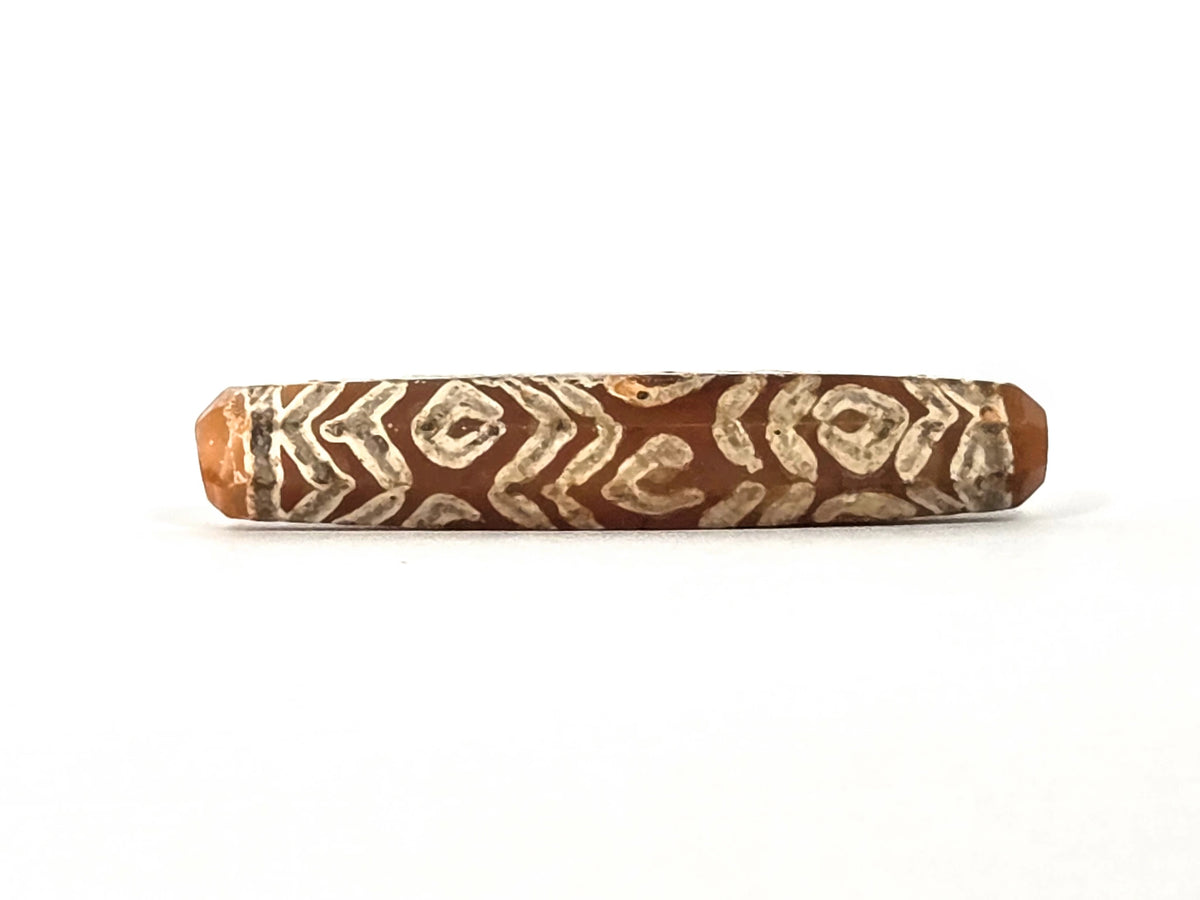
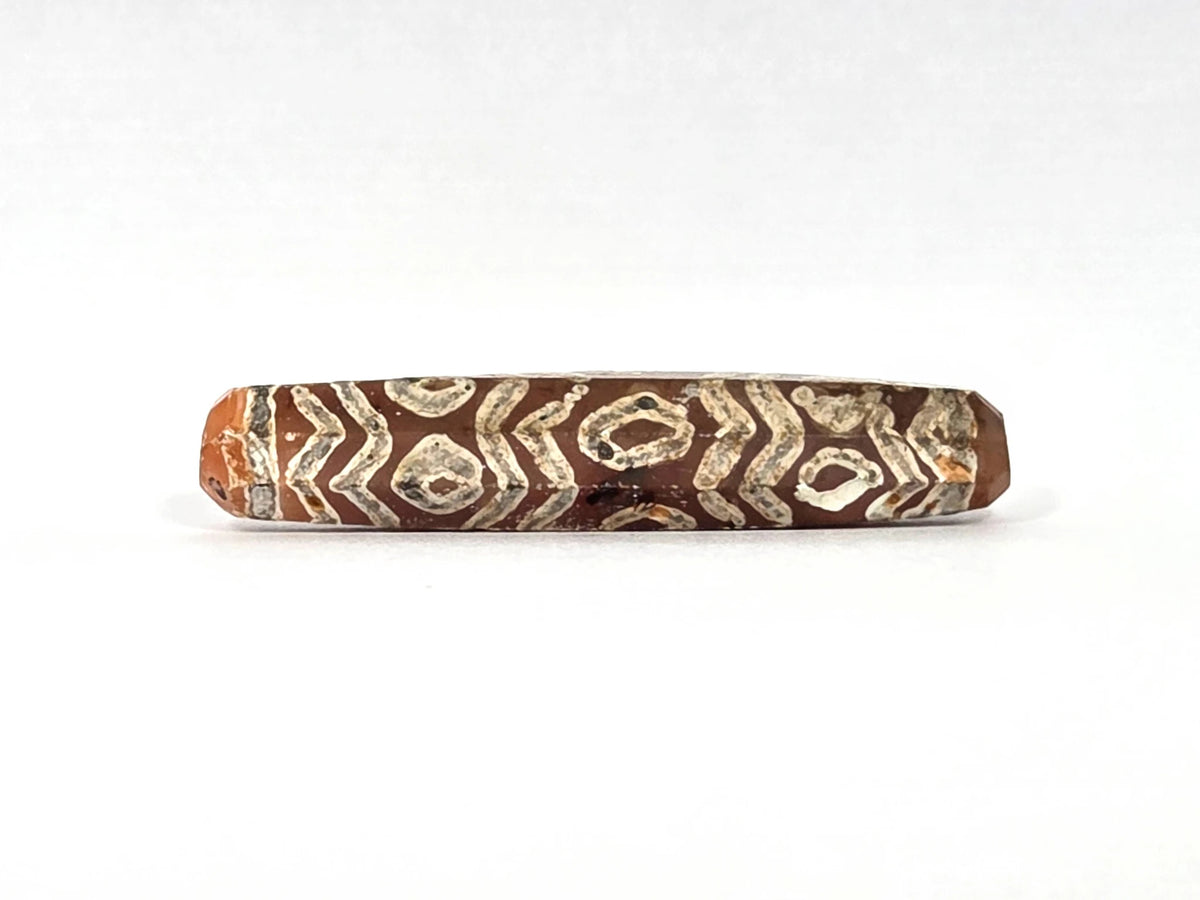
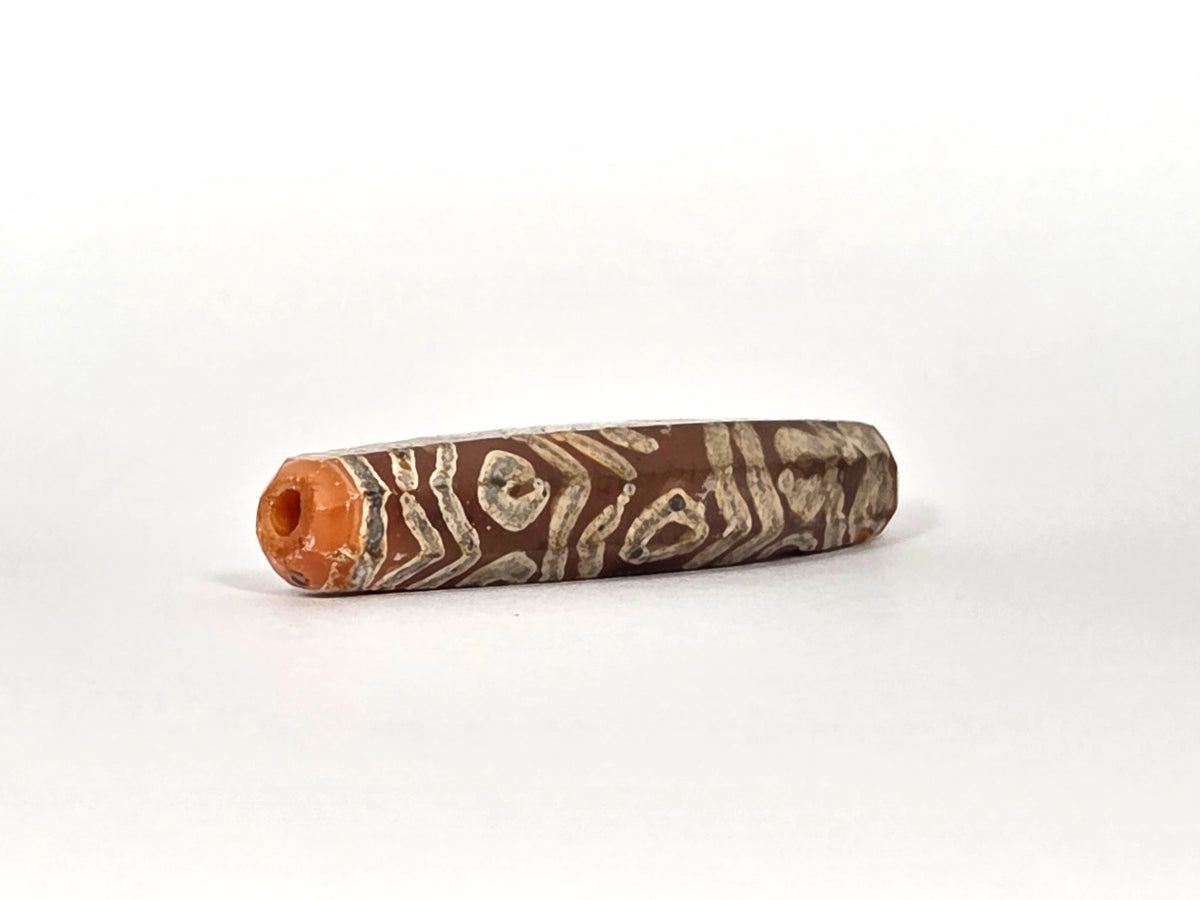
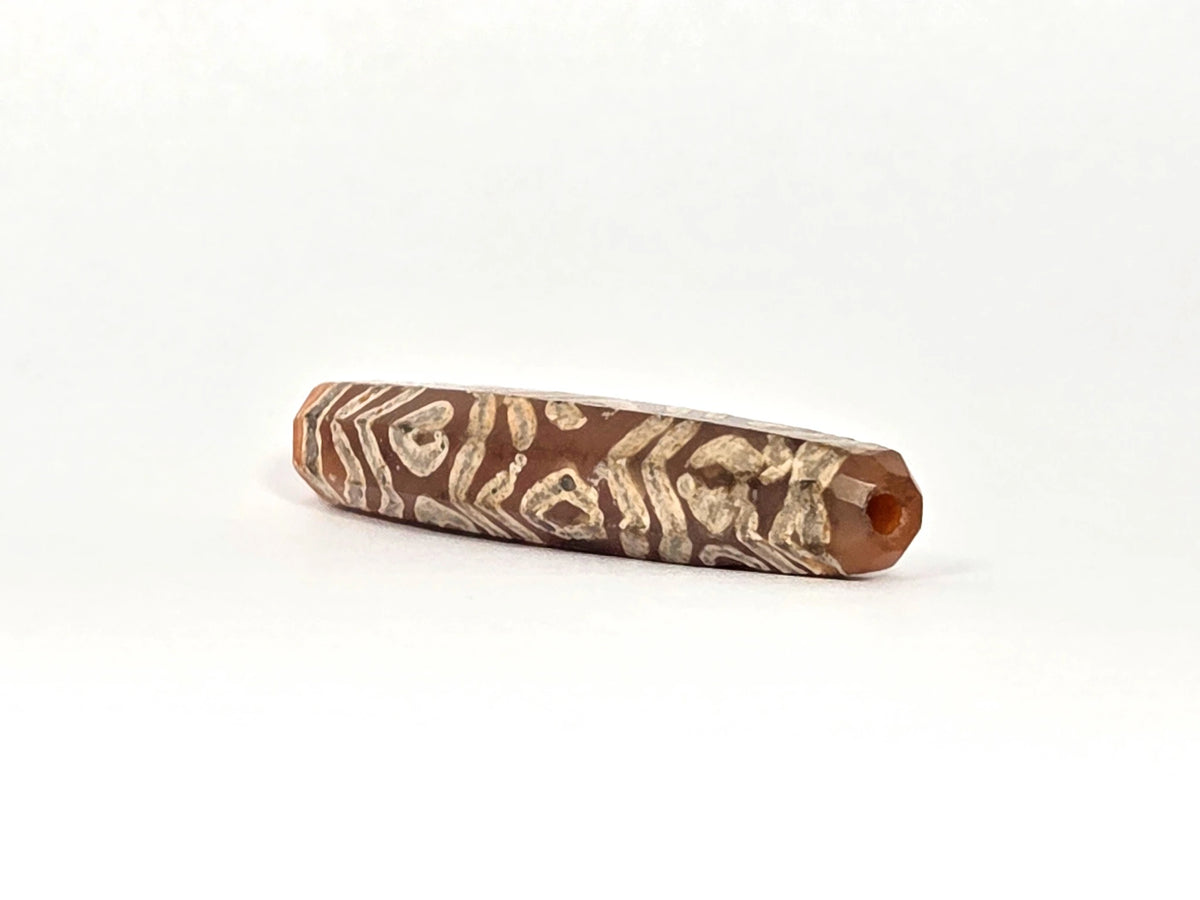
This bead measures 45.2 mm along its long axis and 9.3 mm at its widest point — an unusually slender, elongated cylinder for a piece of this age and motif complexity. Like the eight-sided faceted carnelian beads produced in this tradition, its cross-section is octagonal: eight flat faces running the full length of the barrel, meeting at defined ridges, giving the bead a distinctly angular profile when viewed from the end. The form is immediately apparent in the angled end photographs, where the regular eight-sided polygon is visible at each aperture. Each face had to be ground flat and aligned with the others before any surface work could begin — a labor-intensive preparation that reflects the quality of the commission the piece represented.
The carnelian ground is a warm reddish-orange to medium reddish-brown, brighter and more saturated in hue than the deeper amber seen in some ancient carnelian pieces — the color of a well-fired carnelian with good iron oxide content, which produces the characteristic orange-brown range valued in ancient bead-making traditions across Central and South Asia. In direct light the carnelian has depth; the photographs capture its warmth but not its full translucency.
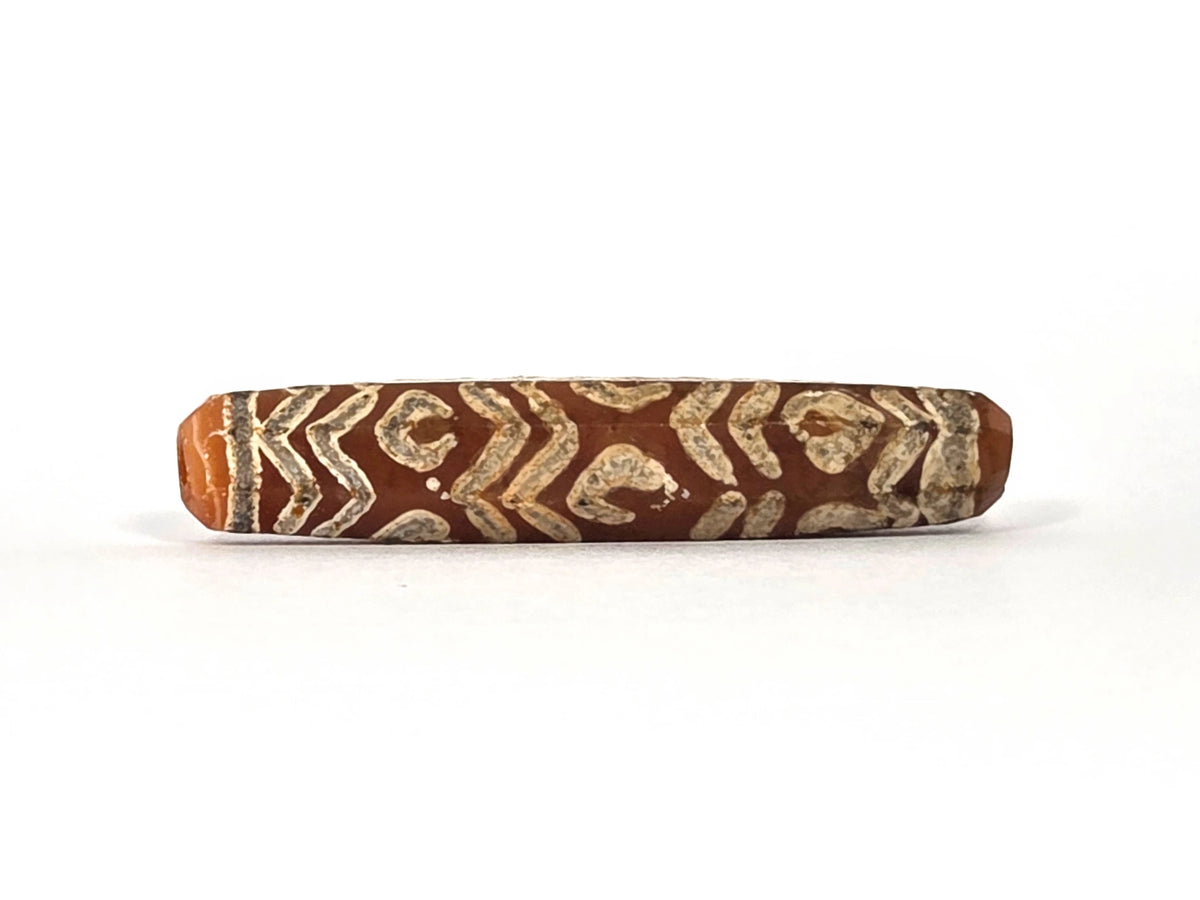
The etching is dense and full-surface: the cream-white lime etching covers the barrel comprehensively, distributed across all eight faceted faces with very little bare carnelian ground showing between the motif elements. This density of etching is characteristic of pieces in this motif class, where the composition is understood as a field rather than as discrete elements on an open ground. The etching has the granular, slightly raised texture of genuine ancient lime-etched carnelian, consistent with a piece of this age.
The motif combines two elements that work in close visual relationship across the barrel surface. The first is the twelve-eye motif: repeating diamond and lozenge-outline frames, each enclosing a small elongated oval or teardrop eye shape, distributed across the barrel in horizontal registers. The eye-within-diamond units repeat continuously around the circumference, so that the full count of twelve eyes is distributed across the full surface of the piece. The second element is the tiger wave: rows of chevron and zigzag forms running as horizontal band lines between the registers of eye units, their V-shaped and arrow-form lines creating a visual rhythm of alternating movement between the more static eye elements. The two elements reinforce each other — the diagonal energy of the chevron bands contrasts with the enclosed, centered quality of the eye forms — and together they produce a composition that covers the surface without repetition feeling mechanical.
The angled end photograph (image 4) shows a grey-white mineral deposit on one tip of the bead, partially encrusting the orange carnelian face around the drill hole aperture. This is calcification — a natural accumulation of calcium carbonate and other mineral compounds from long-term soil contact and burial environment — and its presence is among the most reliable physical indicators of genuine antiquity in ancient beads. Calcification of this character cannot be reproduced artificially; it develops over centuries through sustained contact with the specific mineral chemistry of the burial environment, and collectors and authentication specialists recognize it as a mark of age rather than a condition issue. The opposite tip (image 5) is clear, and the etched motif across the full barrel is intact.
Ancient Etched Carnelian
Etched carnelian beads are among the oldest continuously produced decorated beads in the ancient world, with production documented from the Indus Valley Civilization onward. The lime-etching technique — applying an alkaline paste to the carnelian surface and firing it to produce permanent white markings — was developed in the third millennium BCE and continued in use across Central and South Asia through the medieval period and beyond. Beads decorated with eye motifs — whether single eyes, paired eyes, or multi-eye compositions of the kind seen here — carry associations with protection, warding, and auspiciousness across the cultures that produced and used them. The twelve-eye composition represents a high-complexity example of this tradition, requiring a more demanding layout and execution than simpler single-motif pieces, and the combination with tiger wave banding reflects a mature compositional approach that integrates protective eye symbolism with dynamic movement motifs in a single unified surface treatment.
Specifications
Motif: Twelve-eye and tiger wave — repeating diamond-framed eye units (small elongated oval or teardrop eye within each diamond outline) distributed across all faceted faces; chevron and zigzag tiger wave band lines between eye registers; full-surface cream-white lime etching on warm reddish-orange carnelian ground
Length: 45.2 mm
Diameter: 9.3 mm
Form: Eight-sided (octagonal) faceted cylinder
Material: Natural carnelian
Color: Warm reddish-orange to medium reddish-brown carnelian ground; cream-white lime etching
Age Estimate: Ancient — 1500–2000 years
Condition: Good. Etching intact across all faceted faces. Calcification on one tip face — grey-white mineral deposit from long-term burial environment, a recognized indicator of genuine antiquity. Both drill holes functional.
Bloodspots: N/A (carnelian)
Product ID: AC-101426-12E
Collections: Ancient Dzi · All Products
Other ancient beads in the collection:
- AC-101226-EC — Ancient Etched Carnelian Bead, Eight-Sided Faceted Barrel, 31.1 mm
- AC-101126-RS — Ancient Round Agate Bead, Stars Motif, 22.3 mm
- AC-B-092526-9E — Ancient Nine-Eye Dzi Bead with Bloodspot Patina, 45.5 mm
Further reading: How to Identify Genuine Ancient Dzi Beads · Tibetan Dzi Beads: Luck, Fortune & Meaning
Every piece at Ancient Dzi Shop is photographed unretouched and described exactly as found. What you see is what you will receive.
Photos: Unretouched images of the exact bead listed. Five product photographs: three white-background lateral profile views showing the full-surface twelve-eye and tiger wave etching, the dense cream-white motif composition from different rotational angles, and the octagonal faceted cylinder form (facet ridges clearly visible in image 3); two angled end views showing both drill hole apertures, the octagonal cross-section, and — in image 4 — the grey-white calcification deposit on one tip face.
#ancientethedcarnelian #carnelianbeads #etchedcarnelian #ancientbead #himalayanbead #ancientamulet #twelveeyecarnelian #tigerwavecarnelian #etchedbead #ancientdzishop #dzicollector #tibetanantiques #agatebeads #ancientstone #ancientjewelry
无法加载取货服务可用情况