Summer Sale! Enjoy 30% Discount At Checkout


Ancient Dzi Shop
Guru Rinpoche Dharma Cap Dzi, 43.3×11.8mm, Deep Warm Dark Chocolate-Brown Agate (Ac-061926-GRDC)
Guru Rinpoche Dharma Cap Dzi, 43.3×11.8mm, Deep Warm Dark Chocolate-Brown Agate (Ac-061926-GRDC)
We never retouch our photos. What you see is exactly what you will receive.
Every face of this bead carries a different composition, and not one of them repeats.
That is the first thing to understand about the Guru Rinpoche Dharma Cap motif: it is not a pattern. It does not tile. There are no rows of eyes, no alternating faces, no wave that runs the same direction twice. The cream-white lines cover the entire surface of the bead in a continuous interlocking composition — crown forms, scroll curves, bracket elements, enclosed diamond voids — and each face presents a different cross-section of that composition. Turn the bead and the reading changes completely. There is no front. There is no back. There is only the cap, seen from every angle simultaneously.
Face A (Image 2) shows the most immediately readable Dharma Cap element: a stepped crown outline in the upper centre, its flat top and curving sides descending into a dense field of flanking scrolls and lower C-curl forms. The centre of this face carries the full force of the composition — the ground between the cream-white lines shifts from near-pitch-black in the tightest zones to warm dark chocolate-brown in the broader fields, giving the face a depth that changes depending on how the light falls.
Face B (Image 3) presents the brim: a wide cream-white oval form with a dark interior, capped by a horizontal bar above — the cap's body seen straight-on, its contained dark centre reading as the dimensional interior of the hat form. Below and flanking: bracket scrolls extending outward. Face C (Image 4) carries the pointed arch of the cap peak above a squared bracket frame — the most architectural reading of the four faces. Face D (Image 5) dissolves the form most completely, the cap elements broken into diagonal chevron pairs and C-curves that read as pure composition rather than recognisable object.
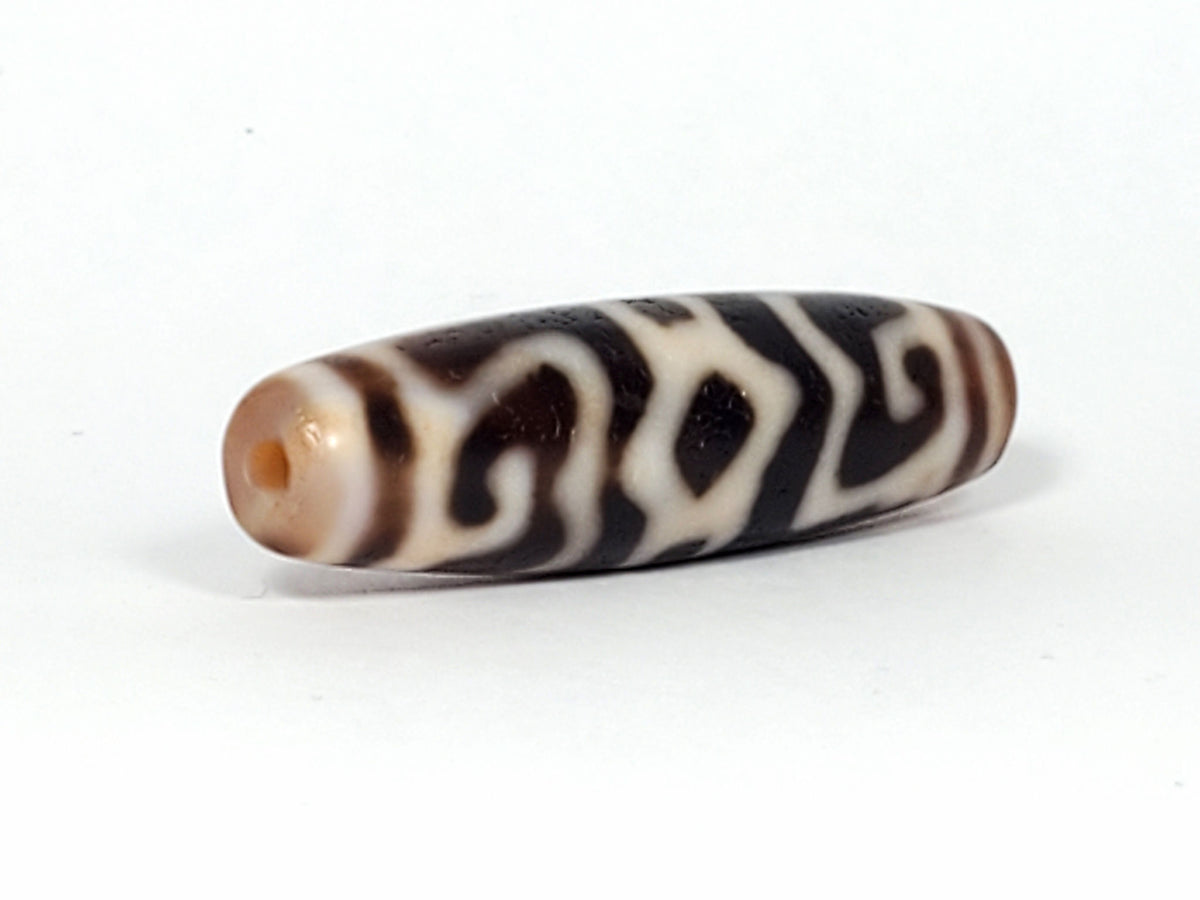
The angled photographs (Images 6 and 7) reveal another element not visible in the flat-face shots: enclosed diamond-shaped dark voids running along the upper face of the bead — the lotus design on the cap itself, visible across two to three positions from each tip angle. These diamond voids, framed tightly in cream-white, are among the finest details in the composition and confirm that the motif extends continuously across the full surface without interruption.
The ground throughout is deep warm dark chocolate-brown natural agate. The motif lines are cream-white, bold and consistent in width, with warm honey-brown tones where the lines narrow and the agate warms the etching from beneath. The end caps at both tips are warm honey-brown — smooth, domed, with small neat drill holes carrying warm reddish-brown interiors. The surface is semi-gloss, with fine age micro-granularity visible in the dark ground zones of Faces C and D at close examination, consistent with 500–700 years of surface weathering. A single fine surface pinhole is visible near the upper centre of Face C (Image 4) — disclosed.
Note on bloodspots: The original listing notes bloodspot inclusions. Macro documentation has not been provided in this set of photographs. Owner to confirm and supply macro image if bloodspot section is to be added before publishing.
Differentiation note: This is the only Guru Rinpoche Dharma Cap dzi in the collection — and one of the most compositionally complex objects in the entire inventory. Every other bead in this collection carries a motif that either repeats across faces or isolates elements between faces. The GRDC carries a single continuous non-repeating all-over composition that covers the full bead surface. There is nothing else in this collection that reads the same way.
Guru Rinpoche's Dharma Cap Motif
Guru Rinpoche (蓮花生大士, Liánhuāshēng dàshì; Padmasambhava) is one of the most revered figures in Tibetan Buddhism, credited with bringing the Vajrayana teachings to Tibet in the eighth century. His distinctive lotus-crowned hat — the Dharma Cap (法王帽, fǎ wáng mào) — is a recognised sacred symbol in Tibetan iconography, depicted in thangkas, statuary, and ritual objects across more than a thousand years of practice. The hat's form — pointed crown, wide brim, lotus-flower cap design — encodes within it a complete teaching: the trident at the top representing the three kayas, the lotus the purity of enlightenment, the crown the sovereign authority of the dharma.
A dzi bead carrying this motif is understood as a direct invocation of Guru Rinpoche's blessing — specifically his qualities of wisdom, power, and the ability to clear obstacles rooted in ignorance. In the Tibetan tradition, such a bead would not be worn casually; it is a practice object, a consecrated vehicle for the energies it represents.
Specs
Motif: Guru Rinpoche's Dharma Cap (法王帽, fǎ wáng mào); continuous all-over non-repeating composition covering entire bead surface; key elements across four faces: stepped crown outline (Face A), wide oval brim with horizontal cap bar (Face B), pointed arch cap peak with bracket frame (Face C), diagonal chevron and scroll dissolve (Face D); enclosed diamond/lozenge lotus voids visible across upper face in angled views; no face repeats another
Length: 43.3mm
Diameter: 11.8mm
Form: Elongated fusiform; acutely tapering to narrow rounded tips
Material: Natural agate; deep warm dark chocolate-brown ground (near-pitch-black in tightest motif zones); cream-white to warm honey-brown motif lines; warm honey-brown end caps; warm reddish-brown drill hole interiors
Age Estimate: 500–700 years
Condition: Semi-gloss surface with age micro-granularity in dark ground zones; single fine surface pinhole near upper centre of Face C disclosed; both drill holes small, neat, well-centred; no cracks; no chips; no medicine digs
Bloodspots: Owner to confirm — original listing notes bloodspot inclusions; macro documentation not available in current photo set; section to be updated upon receipt of macro image
Product ID: Ac-061926-GRDC
Collection: Ancient Dzi Beads
You may also like
For ancient dzi beads with complex all-over compositions, see Ac-032326-9E5 (continuous meander nine-eye, 1,000+ years) and Ac-061926-DC4E (Dharma Conch four-eye, 500–700 years, similarly rare secondary motif pairing).
For ancient agate dzi at comparable age and scale, see Ac-080425-4E (800–1,000 years, square-framed eyes) and Ac-052525-2E (1,000+ years, first ancient two-eye in collection).
For the antique Green Tara dzi — another bead in this collection where the motif resolves differently on every face: At-043026-GT (41.4×12.0mm, 200+ years).
From the blog
Who Is Guru Rinpoche? Padmasambhava and the Vajrayana Tradition in Tibet
What Makes a Dzi Ancient? Understanding Age, Surface, and Acid Etching
(Owner to verify blog URLs before publishing)
Five hundred years of hands have turned this bead, and each time it was turned, it showed them something different.
We never retouch our photos. What you see is exactly what you will receive.
📷 We never retouch our photos. Every bead is photographed exactly as it is. What you see is what you receive.
Hashtags
#AncientDziShop #DharmaCapDzi #GuruRinpocheDzi #法王帽 #蓮花生大士 #AncientDzi #TibetanDzi #DziBeads #PadmasambhavaDzi #TibetanAntiques #AncientDziBeads #RareDzi #NaturalAgate #Ac061926GRDC #TibetanHeritage
Couldn't load pickup availability