Summer Sale! Enjoy 30% Discount At Checkout


Ancient Dzi Shop
Three Eye Dzi, 2+1 Split Distribution, 50.8×12.9mm, Pitch-Black Ground, Blue-Toned Third Eye (Ac-030525-3E)
Three Eye Dzi, 2+1 Split Distribution, 50.8×12.9mm, Pitch-Black Ground, Blue-Toned Third Eye (Ac-030525-3E)
We never retouch our photos. What you see is exactly what you will receive.
Two of the three eyes on this bead share the same warm honey-brown inner zone — but the third eye, on the opposite face, has turned blue.
That blue is not a treatment or a trick of the light. Image 4 shows it clearly: the inner ring zone of the third eye, on Face B, reads as a cool pale blue-grey — distinct from the warm honey-orange inner rings of the two Face A eyes and distinct from every other eye in this collection. It is the same agate, the same etching process, the same bead — and yet the third eye carries a different colour entirely. The most likely explanation is the differential mineral composition of the agate in that zone, where the natural stone and the century-long interaction with cinnabar inclusions beneath the surface has produced a different optical effect in the cream layer. Whatever the mechanism, the result is a bead where one of its three eyes looks unlike the other two — and the photographs show it without retouching of any kind.
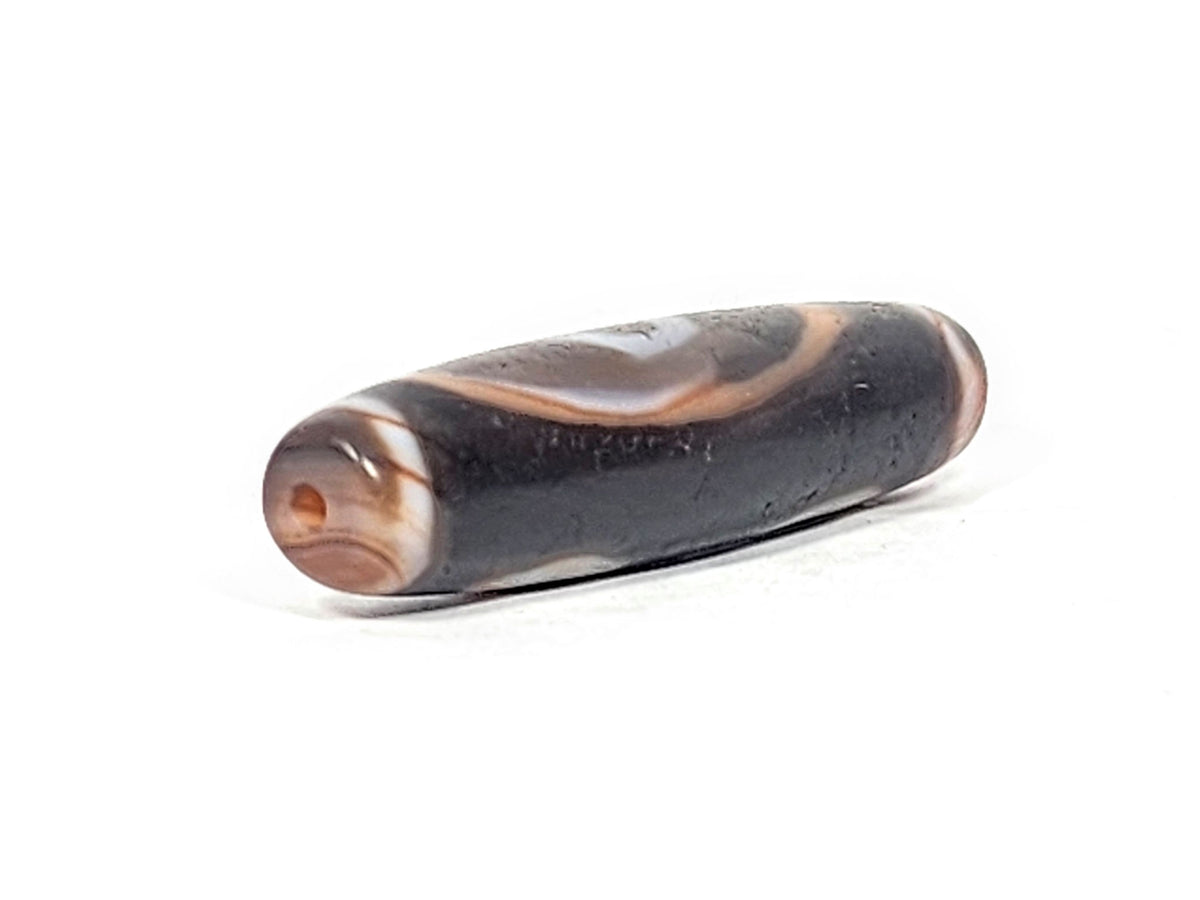
The bead is a long, slender fusiform at 50.8×12.9mm, pitch-black throughout the body (confirmed against white backgrounds), with warm reddish-brown to chocolate-brown end caps at both tapered tips where the natural agate colour was not fully reached by the acid darkening process. The drill holes at both ends are small, well-positioned, with warm reddish-brown to terracotta-orange interiors visible in Images 6 and 7. The body has a semi-matte to semi-gloss surface consistent with five to seven centuries of use and handling — the pitch-black ground carries a fine granular micro-texture visible in close-up that is one of the clearest age markers on this bead.
The three eyes are distributed 2+1: two eyes on Face A, one eye on Face B. They are never all visible simultaneously — to see all three, you must turn the bead. On Face A, the two eyes sit side by side in the central field, each a fully closed oval ring with a cream-white outer ring, a warm honey-orange to sandy-brown inner zone, and a dark brown-black pupil. The rings are bold and large relative to the bead diameter, occupying most of the face width and reading clearly from any distance. On Face B, the single third eye is centred on the opposite lateral face — a cream-white outer ring enclosing the distinctive pale blue-grey inner zone and a dark brown pupil. The upper and lower connector faces (Images 3 and 5) carry warm honey-brown to reddish-brown wave connector bands across the pitch-black ground, linking the two lateral faces. On the connector faces the natural agate banding is also visible — warm chocolate-brown and reddish-brown horizontal stripes in the agate stone that run beneath the etching and show through at the end zones of each face.
Bloodspots are present on this bead. In the dzi tradition, bloodspots are inclusions of cinnabar (硃砂, zhūshā) — mercuric sulfide — that occur naturally within the agate stone and are revealed through the acid etching process that whitens the motif zones. The warm honey-orange tinting visible in the inner ring zones of the two Face A eyes is consistent with cinnabar influence in those agate layers: the inclusions beneath the cream surface are close enough to the top to affect the colour seen above them. The relationship between these warm-toned inclusions and the cool blue-grey of the Face B eye is a further dimension of this bead's bloodspot character — the cinnabar and the natural agate interacting differently in different zones to produce two entirely distinct optical results. No discrete surface bloodspot dots are visible in the photographs; the inclusions here manifest as pervasive tonal influence within the eye zones rather than as point inclusions.
In this collection, At-053126-3E is the only other three-eye bead — one octagonal-frame eye and two open C-rings on a carnelian ground, antique period, 51.2×13.0mm. Ac-030525-3E differs across every dimension: the eyes here are all fully closed oval rings rather than open C-rings; the ground is pitch-black agate rather than carnelian; the three eyes are all genuinely closed forms; and the blue-toned third eye has no equivalent anywhere in the collection.
The Three Eye Motif 三眼天珠
The three-eye dzi (三眼天珠, sān yǎn tiānzhū) is one of the most sought-after configurations in Tibetan dzi tradition. Three is the number of completeness in Buddhist cosmology — the Three Jewels (三寶, sānbǎo): the Buddha, the Dharma, and the Sangha. A three-eye dzi is understood as a bead that holds all three simultaneously — the teacher, the teaching, and the community of practitioners — making it a complete field of refuge in a single object. It is also associated with the three aspects of time: past, present, and future; and with the three planes of existence in Buddhist cosmological mapping. The eye motif in dzi tradition represents the eye of wisdom — the capacity to perceive the true nature of phenomena, to see through surface appearance to underlying cause. Three such eyes, distributed so that they can never all be seen at once, ensure that the wisdom they represent operates in every direction and is never fully exhausted by any single viewing.
Spec Block
Motif: Three Eye 三眼天珠 (sān yǎn tiānzhū); 2+1 distribution — two fully closed oval ring eyes on Face A (side by side), one fully closed oval ring eye on Face B (opposite lateral); warm honey-orange inner zones on Face A eyes; cool pale blue-grey inner zone on Face B eye; warm wave connector bands on upper and lower faces
Length: 50.8mm
Diameter: 12.9mm
Form: Elongated fusiform; round cross-section; symmetrically tapered at both ends; small well-positioned drill holes at both tips
Material: Pitch-black agate ground throughout body; warm reddish-brown to chocolate-brown natural agate end caps; cream-white etched eye rings with warm honey-orange (Face A) and cool pale blue-grey (Face B) inner zones; warm honey-brown wave connector bands on upper and lower faces
Age Estimate: 500–700 years
Condition: No chips, cracks, medicine digs, or rework; semi-matte to semi-gloss surface with age-appropriate granular micro-texture on pitch-black ground; end caps and connector faces show natural agate banding
Bloodspots: Yes — cinnabar (硃砂, zhūshā) inclusions manifesting as warm honey-orange tonal influence in Face A eye inner zones and contributing to the distinctive pale blue-grey tone of the Face B eye inner zone; pervasive sub-surface presence rather than discrete surface dots
Product ID: Ac-030525-3E
Collection: Ancient Dzi Beads | Three Eye Dzi
You May Also Like
Other eye dzi and ancient agate pieces from this collection:
At-053126-3E — Antique Three Eye Dzi — the only other three-eye bead in the collection; one octagonal-frame eye + two open C-rings; carnelian; 51.2×13.0mm
At-092724-2EBS — Antique Two Eye Dzi with Bloodspots — pervasive cinnabar; rose-peach tinted cream lines; 41.0×13.0mm
At-042626-4E3 — Antique Four Eye Dzi — pitch-black ground; rust-orange cinnabar micro-dots; bright white square-framed eyes; 47.5×13.6mm
At-072625-5E — Antique Five Eye Dzi — pitch-black ground; 2+3 eye split; honey-tan end caps; 44.5×12.4mm
Further Reading
What Are Dzi Beads? Origins, Meaning & Collecting Guide
Understanding the Eye Motif in Tibetan Dzi Tradition
Three eyes, two faces, one bead — and the blue one is always on the other side.
We never retouch our photos. What you see is exactly what you will receive.
📷 We never retouch our photos. Every bead is photographed exactly as it is. What you see is what you receive.
#ThreeEyeDzi #三眼天珠 #AncientDziBead #TibetanDzi #PitchBlackDzi #BloodspotDzi #DziCollector #AncientDziShop #CinnabarDzi #EyeMotifDzi #Ac030525-3E #AncientAgate #TibetanAntiques #RareDzi #BlueEyeDzi
Couldn't load pickup availability