Summer Sale! Enjoy 30% Discount At Checkout


Ancient Dzi Shop
Tiger Tooth & Lotus Dzi, Near-Sphere Form, 25.4×20.1mm, Deep Dark Grey-Brown, Mirror Gloss (At-061826-RTTL)
Tiger Tooth & Lotus Dzi, Near-Sphere Form, 25.4×20.1mm, Deep Dark Grey-Brown, Mirror Gloss (At-061826-RTTL)
We never retouch our photos. What you see is exactly what you will receive.
The tiger tooth on this bead does not stay where you first see it — turn the sphere a quarter turn and it has become a lotus; turn it again and it has become something that is neither one nor the other.
That is what a near-spherical dzi does to any motif it carries. On an elongated fusiform, the composition has a front face and a back face, a primary reading and a secondary one. On a near-sphere, there is no primary face — the motif is continuous, and every quarter turn produces a completely new composition from the same set of elements. This bead is 25.4mm long and 20.1mm across, close enough to round that when you set it down it can rest on any face without preference. The motif was designed for that: tiger tooth chevrons, lotus scrolls, and three vertical stripe bands that run pole to pole, dividing the surface into fields that read differently depending on which field is facing you.
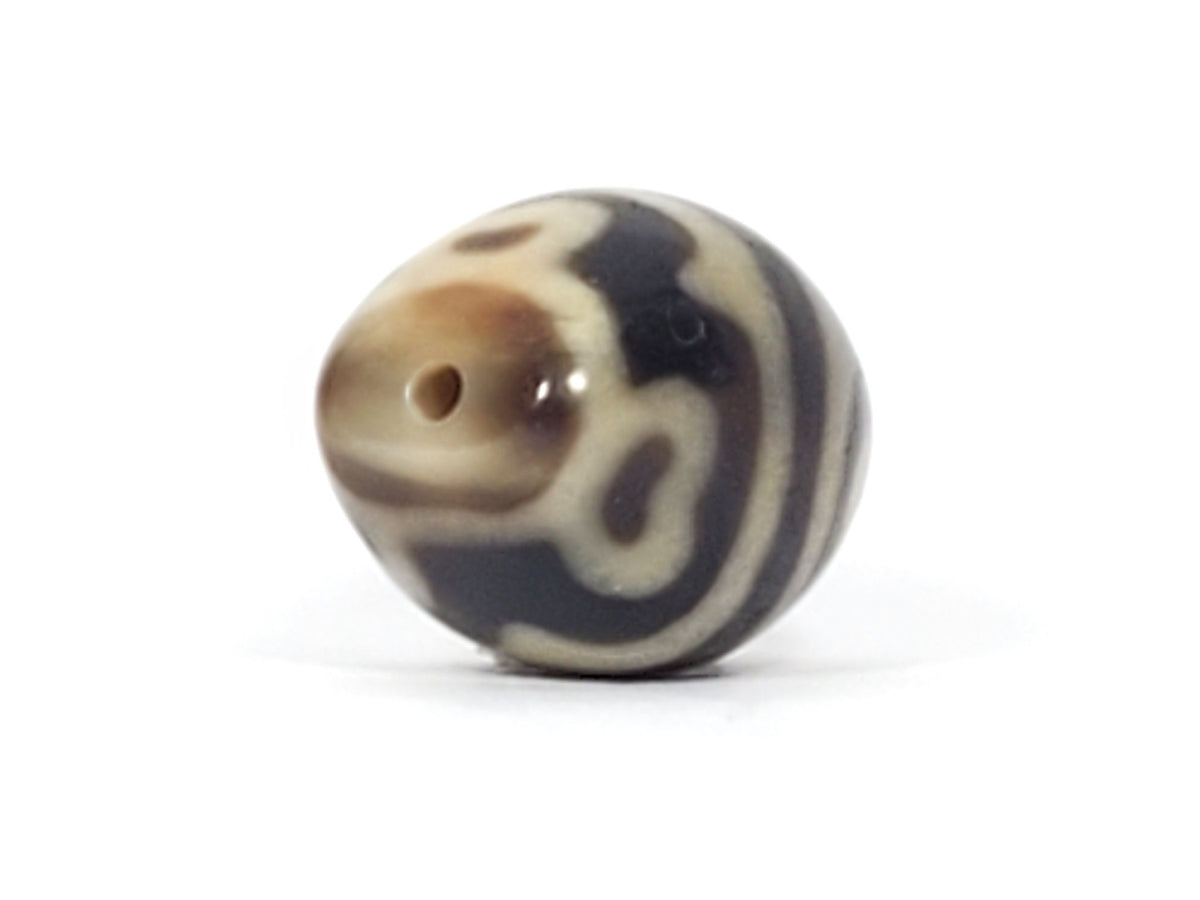
Face A shows the tiger tooth at its most legible: three cream-white vertical stripes divide the dark ground into fields, each field containing a hooked C-chevron — the tiger tooth hook, the pointed inward-curving element that is the defining mark of this motif type. Rotate 90° to Face B and the composition transforms: the central field now shows a cream-white hourglass or waist element flanked by lotus scroll forms — curved S-curves with a dark circular dot at each terminal, the lotus curl rendered in the ancient convention. The lotus elements appear in bilateral symmetry across the face, two per side, four total. Rotate again to Face C and the tiger tooth and lotus have combined into compound forms — P-shaped and reversed-P elements where the hook of the tooth and the curl of the scroll cannot be separated from each other. The same etching generates three distinct readings. The six photographs show you all of them.
The ground is deep dark grey-brown with warm chocolate-brown undertones visible in certain light conditions — confirmed from white-background photographs as a warm dark tone rather than pitch-black. The motif lines are warm cream-white to sandy-cream, well-defined and consistent throughout the entire surface. The drill holes at both poles are very small and fine, well-centred in warm honey-brown natural agate pole zones — the same tip-colour phenomenon visible in acid-etched dzi where the extreme poles retain more of the agate's natural warmth.
The surface is the most distinctive condition feature of this bead: a high-gloss mirror finish that is uniformly maintained across the entire sphere, across every face, across every motif element and every ground zone. There is no area of dulling, no wear flattening, no loss of gloss at the poles where handled beads most commonly show attrition. This is the surface of a bead that was kept, not worn — held in stillness rather than carried through friction. The existing record for this piece notes it was likely an altar piece, and the photographs support that assessment fully. One tiny pinhole is present on the body surface, visible in Images 4 and 6 — a natural agate inclusion, disclosed completely. It does not affect the structural integrity or the visual reading of the motif. No chips, cracks, medicine digs, or other surface damage are present. No bloodspot inclusions are detected in any photograph.
In this collection, the round form in dzi is rare. Antique Tibetan Fifteen Eye Motif Dzi Bead is a near-perfect sphere in carnelian carrying a continuous lotus network — ancient, 1,000–2,000 years. The vintage round pairs Pair of Round Treasure Vase Dzi Beads and Antique Double Wave Dzi Bead are round but Taiwan-period. At-061826-RTTL is the only antique agate near-sphere in the collection, and the only piece where the tiger tooth and lotus motifs combine on a continuous spherical surface — making its multi-reading quality impossible to replicate in any elongated form.
The Tiger Tooth & Lotus Motif 虎牙蓮花天珠
The tiger tooth (虎牙, hǔyá) in dzi tradition is the motif of protective force — the tooth of the guardian animal, carried to deflect harm, to project strength, and to give its wearer the capacity to meet any adversary without flinching. On an elongated bead it reads as a directional element, pointing along the axis of the bead. On a sphere it wraps in every direction simultaneously, and that omnidirectionality is the point: protection with no blind side, no unguarded angle. The lotus (蓮花, liánhuā) brings the complementary register — purity of mind arising from impure conditions, the capacity for clarity and wisdom regardless of circumstance. Where the tiger tooth governs the outer life, the lotus governs the inner one. A bead that carries both, on a form that presents both from every angle, holds its wearer in both dimensions at once — protected externally, clear internally, with no face of the bead and no moment of the day left unaddressed.
Spec Block
Motif: Tiger Tooth & Lotus 虎牙蓮花天珠 (hǔyá liánhuā tiānzhū); three vertical stripe bands pole-to-pole dividing surface into fields; Face A: hooked C-chevron tiger tooth elements per field; Face B: central hourglass element flanked by bilateral lotus scroll S-curves with circular dot terminals; Face C: compound tiger tooth and lotus forms; continuous all-over composition
Length: 25.4mm
Diameter: 20.1mm × 20.4mm
Form: Near-sphere; slightly ovoid; narrowed at drill hole poles; no preferred resting face
Material: Deep dark grey-brown agate ground with warm chocolate-brown undertones; warm honey-brown natural agate at pole tips; warm cream-white to sandy-cream acid-etched motif lines; mirror-gloss surface throughout
Age Estimate: 300–500 years
Condition: Mirror-gloss surface intact across entire sphere; one natural agate pinhole on body surface disclosed (visible in Images 4 and 6); no chips, cracks, medicine digs, or rework; exceptional preservation consistent with altar piece provenance
Bloodspots: None detected
Product ID: At-061826-RTTL
Collection: Antique Dzi Beads | Tiger Tooth Dzi
You May Also Like
Other rare forms and tiger tooth pieces from this collection:
Antique Tibetan Fifteen Eye Motif Dzi Bead — the only other near-sphere in the collection; continuous lotus network; carnelian; 1,000–2,000 years
Antique Four Eye Tiger Tooth Dzi — tiger tooth on separate faces from eye motif; 46.4×11.5mm
Three Diamond Eye Tiger Tooth Carnelian Dzi Terracotta — tiger tooth horizontal bar element; terracotta-red carnelian; 300–500 years
Three Eye Tiger Stripe Carnelian Dzi Chocolate Brown — tiger tooth chevron on bicolour carnelian agate; 500–1,000 years
Further Reading
What Are Dzi Beads? Origins, Meaning & Collecting Guide
Ancient Six Eye Lotus Motif Carnelian Dzi
Four faces, two motifs, one sphere — and every angle a different answer.
We never retouch our photos. What you see is exactly what you will receive.
📷 We never retouch our photos. Every bead is photographed exactly as it is. What you see is what you receive.
#TigerToothLotusDzi #虎牙蓮花天珠 #AntiqueDziBead #TibetanDzi #NearSphereDzi #AntiqueDzi #DziCollector #AncientDziShop #TigerToothDzi #LotusDzi #At061826RTTL #AltarPieceDzi #RoundDzi #TibetanAntiques #RareDzi
Couldn't load pickup availability