Summer Sale! Enjoy 30% Discount At Checkout


Ancient Dzi Shop
Lotus & Tiger Tooth Carnelian Dzi, Wide Barrel Form, 28.3×15.8mm, Warm Terracotta-Red (Ac-032320-LTT)
Lotus & Tiger Tooth Carnelian Dzi, Wide Barrel Form, 28.3×15.8mm, Warm Terracotta-Red (Ac-032320-LTT)
We never retouch our photos. What you see is exactly what you will receive.
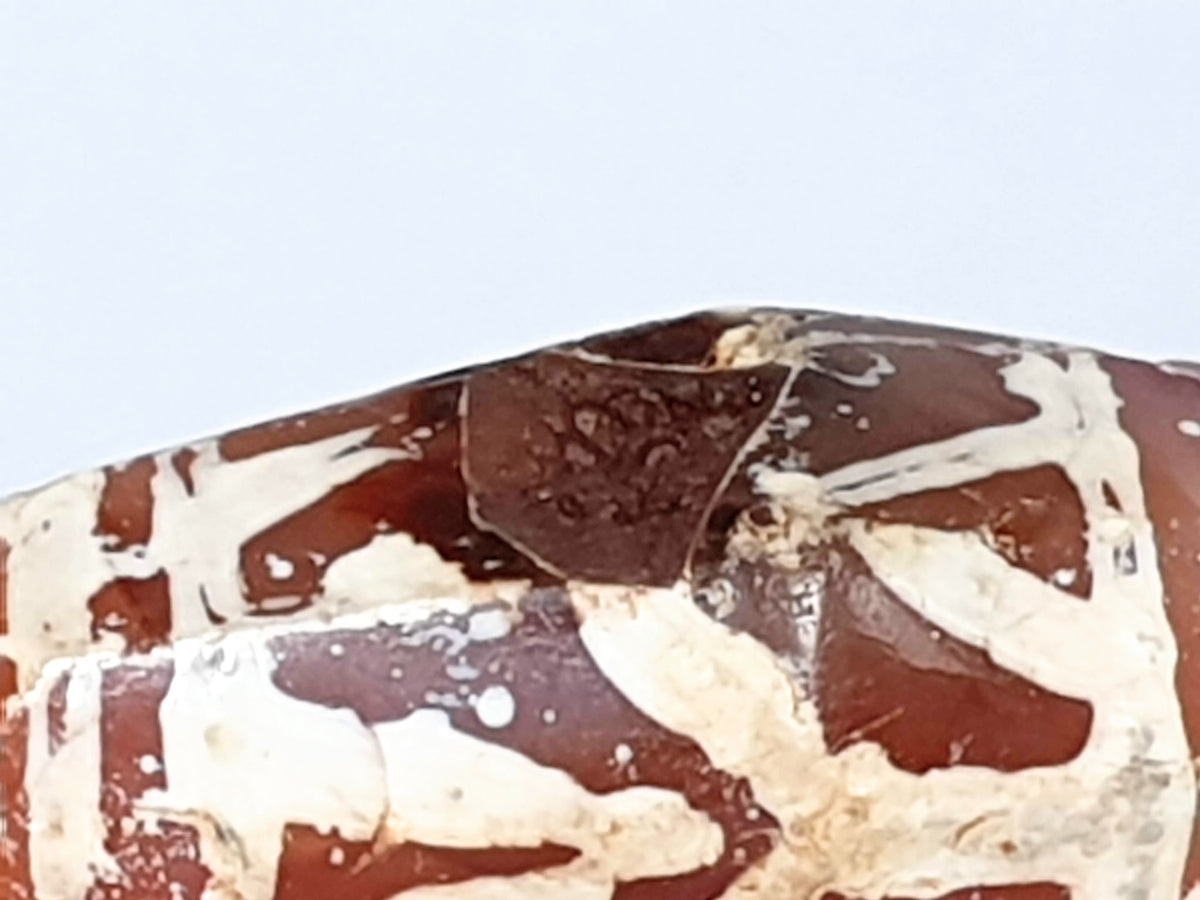
The etching on this bead is not a line — it is a wall; after a thousand years, the mineralised cream-white edges have grown so thick they stand above the carnelian ground like raised stonework.
That texture is the first thing the photographs communicate. Where a younger etched carnelian shows clean, sharp lines sitting flush with the surface, the etching on this bead has accumulated century upon century of mineral saturation until the white marks are thick, rough-edged, and architecturally raised. The cream-white material has a granular, encrusted quality that is visible at full scale and unmistakable in close-up. It is one of the clearest surface markers of extreme age in the acid-etched carnelian tradition.
The ground is a warm, vivid terracotta-red throughout the body — consistent across all four main lateral faces, deepening slightly toward the upper register and carrying a natural reddish-brown variation in places. The end caps are a distinctly lighter warm peach-orange: the same carnelian family, but showing the natural colour differential between the outer body zones and the stone's interior, made visible by the ancient biconal drill technique. The drill hole itself is large and funnel-shaped, characteristic of hand-drilling from both ends without mechanical tooling — the warm orange-red interior of the channel is visible in Image 5 and is one of this bead's most direct age signatures.
The motif runs across both main lateral faces as a combined lotus and tiger tooth composition. The tiger tooth element appears as interlocking V-chevrons — the same pointed, hooked form seen in other ancient carnelian dzi in this collection. Between and around these chevrons, diagonal crossing lines create enclosed pointed-oval zones of exposed carnelian ground, forming the abstracted lotus petal arrangement. On Face A (Images 2 and 3), the composition reads as a dense lattice of crossing motif lines with two registers of petal-enclosed ground zones. On Face B (Image 3), the lotus element is more prominent at centre — a V-arrow form surrounded by diagonal strokes. Vertical stripe dividers flank the main motif field at both edges of each face, consistent with the structural framing seen across the ancient carnelian repertoire. The top and bottom faces carry partial continuations of the motif lines as they wrap the octagonal shoulder edges.
Condition must be clearly understood before purchase. The photographs disclose fully and without retouching: a significant triangular spall and chip on the upper body face (most clearly visible in Images 4, 6, and 7). A section of the carnelian surface and etching layer has broken away in a clean triangular zone, exposing a rougher, darker sub-surface below. A fine hairline crack extends from the upper corner of this chip across the face. The damage is historic — the exposed sub-surface carries the same aged patina and mineral character as the rest of the bead; there are no indicators of recent breakage. This is a bead that has lived through a thousand years, and the photographs show you exactly what that means. Additional surface mineral spotting is distributed across the carnelian ground, particularly visible in Images 3 and 4 as small white dots — this is consistent with the bead's age and does not affect structural integrity. No bloodspot inclusions are detected.
In the context of this collection, Ac-032320-LTT is the only ancient carnelian dzi carrying the lotus and tiger tooth combination, and its wide barrel form — 15.8mm in diameter against just 28.3mm in length — sets it apart from every other elongated carnelian here. The closest formal relative is Ancient Lotus Tiger Tooth Carnelian Dzi Wide Barrel, which shares the tiger tooth chevron language; but where that bead is long and octagonal with a bicolour agate ground, this piece is compact, wide, and red throughout.
The Lotus & Tiger Tooth Motif 蓮花虎牙天珠
In ancient carnelian dzi tradition, the lotus (蓮花, liánhuā) is one of the most layered symbols carried by any bead. It is the flower that rises from mud without staining — the emblem of purity that does not require a pure origin, and of spiritual potential that survives any condition. In Buddhist iconography the lotus throne supports every enlightened figure; a lotus-bearing bead is understood as an object that shares in that quality of untainted arising. The tiger tooth (虎牙, hǔyá) motif brings a different register: strength, ferocity, and protective power. The tiger is the guardian of the mountain pass and the threshold; its tooth, worn or carried, is understood to deflect harm and to give its bearer the courage to meet any force. In combination, the lotus and tiger tooth do not cancel each other — they address different planes. The lotus addresses what the mind becomes; the tiger tooth addresses what the body must navigate. A bead that carries both is a bead that holds the practitioner in both dimensions at once.
Spec Block
Motif: Lotus & Tiger Tooth 蓮花虎牙天珠 (liánhuā hǔyá tiānzhū); interlocking V-chevron tiger tooth elements with diagonal crossing lines forming enclosed lotus petal zones; vertical stripe dividers flanking main field; motif continuous across both lateral faces
Length: 28.3mm
Diameter: 15.8mm
Form: Wide short barrel, slightly octagonal cross-section; rounded shoulders; acutely faceted at both ends; ancient biconal funnel drill holes at both ends
Material: Warm terracotta-red to reddish-brown carnelian ground; peach-orange end caps; cream-white heavily mineralised and texturally raised acid-etched motif lines
Age Estimate: 1,000–1,500 years
Condition: Significant triangular spall and chip on upper body face — historic damage, fully patinated, sub-surface exposed; hairline crack extending from chip disclosed; surface mineral spotting throughout; no structural crack through bead body; no medicine digs; no rework
Bloodspots: None detected
Product ID: Ac-032320-LTT
Collection: Ancient Carnelian Criss Cross Motif Dzi Bead Hexagon Shape | Ancient Dzi Beads
You May Also Like
Other ancient carnelian pieces from this collection worth exploring:
Ancient Lotus Tiger Tooth Carnelian Dzi Wide Barrel — shares the tiger tooth chevron language; bicolour terracotta-red and grey-black agate; octagonal; 500–1,000 years
Ancient Carnelian Criss Cross Motif Dzi Bead Hexagon Shape — similar vivid terracotta-red ground; octagonal; structural geometric motif; 500–1,000 years
Ancient Five Tiger Stripe Carnelian Dzi Calcification — ancient funnel drill hole; octagonal; warm terracotta-red; 800–1,000 years
Antique Two Diamond Eye Tiger Tooth Motif Carnelian Dzi — tiger tooth wave fill; warm terracotta-red ground; 200–500 years
Further Reading
What Are Dzi Beads? Origins, Meaning & Collecting Guide
Antique Six Eye Lotus Motif Dzi Bead
A thousand years of history, carried honestly — damage, patina, and all.
We never retouch our photos. What you see is exactly what you will receive.
📷 We never retouch our photos. Every bead is photographed exactly as it is. What you see is what you receive.
#AncientDziBead #LotusTigerToothDzi #蓮花虎牙天珠 #AncientCarnelian #CarneliaDziBead #TibetanDzi #DziCollector #AncientDziShop #WideBarrelDzi #TigerToothDzi #LotusDzi #Ac032320-LTT #AncientBeads #TibetanAntiques #RareDzi
Couldn't load pickup availability