Summer Sale! Enjoy 30% Discount At Checkout


Ancient Dzi Shop
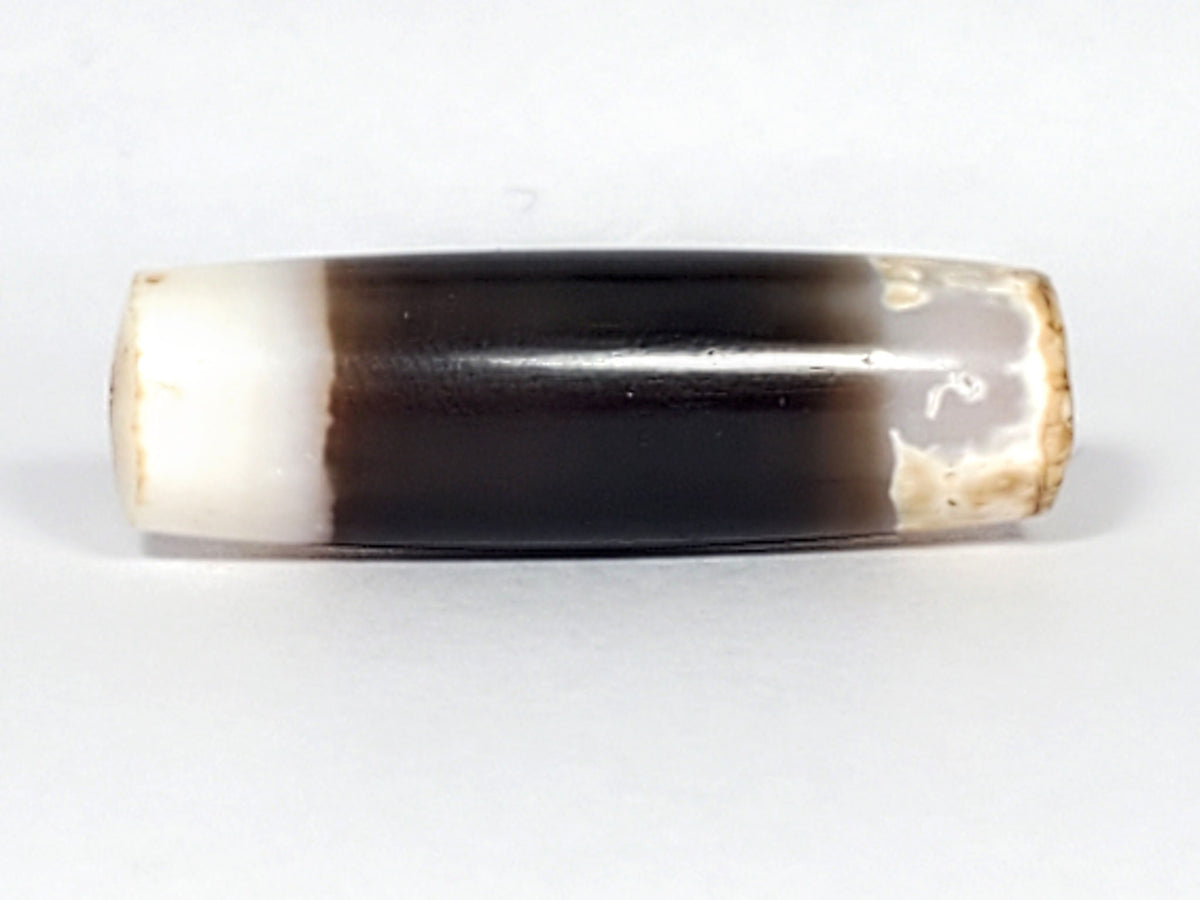
Single Stripe Chung Dzi with Bloodspots, 31.4 × 9.6mm, pitch-black and white, calcified end (Ac-061426-1SChungBS)
Single Stripe Chung Dzi with Bloodspots, 31.4 × 9.6mm, pitch-black and white, calcified end (Ac-061426-1SChungBS)
We never retouch our photos. What you see is exactly what you will receive.
The two ends of this bead have had different lives, and the photographs show you exactly what that means.
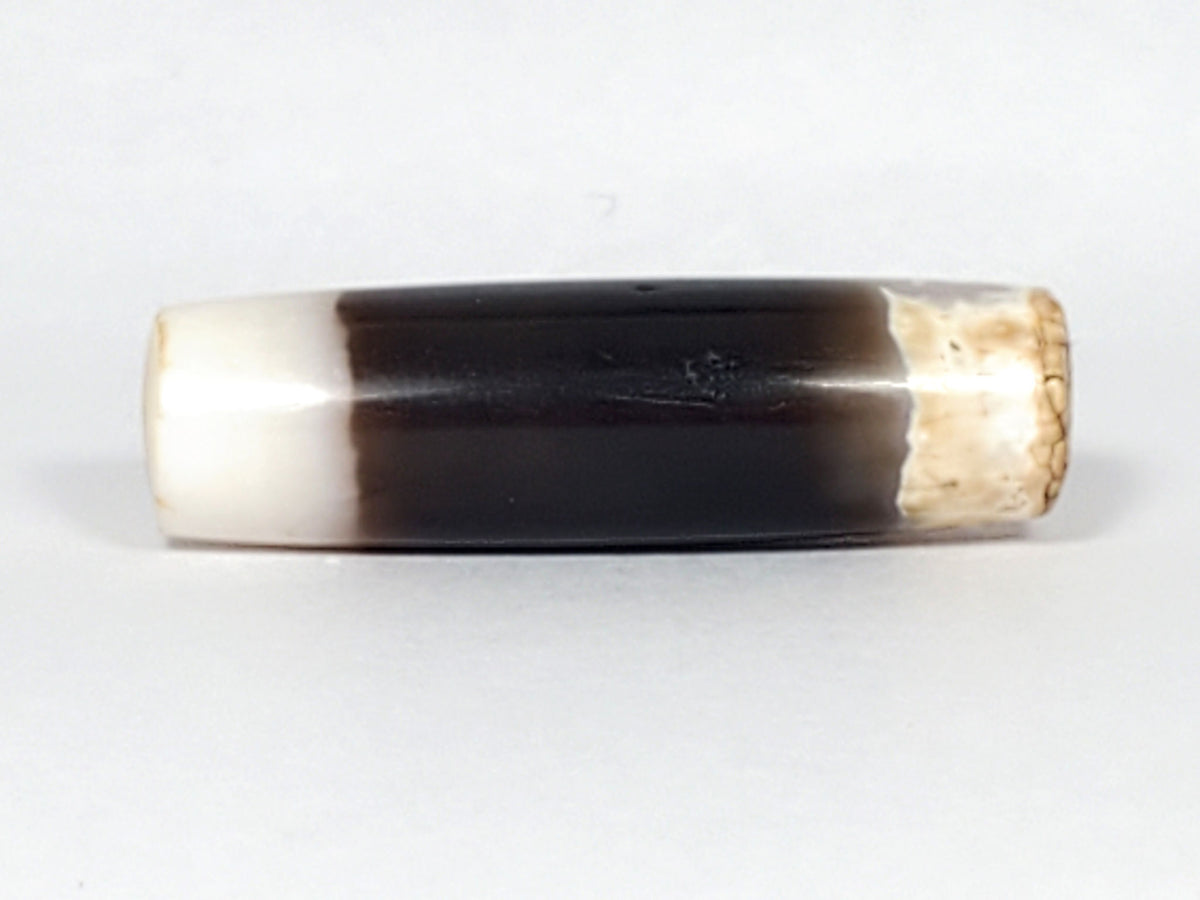
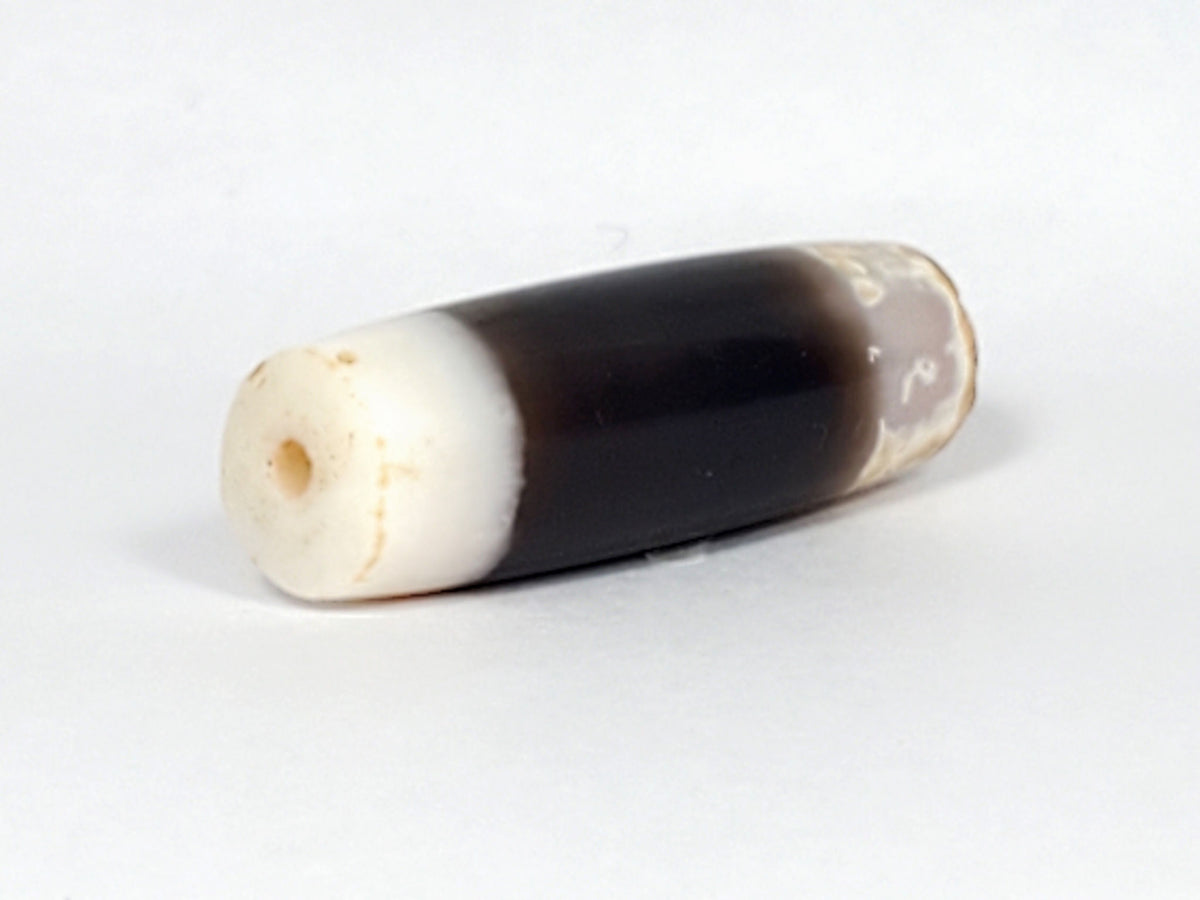
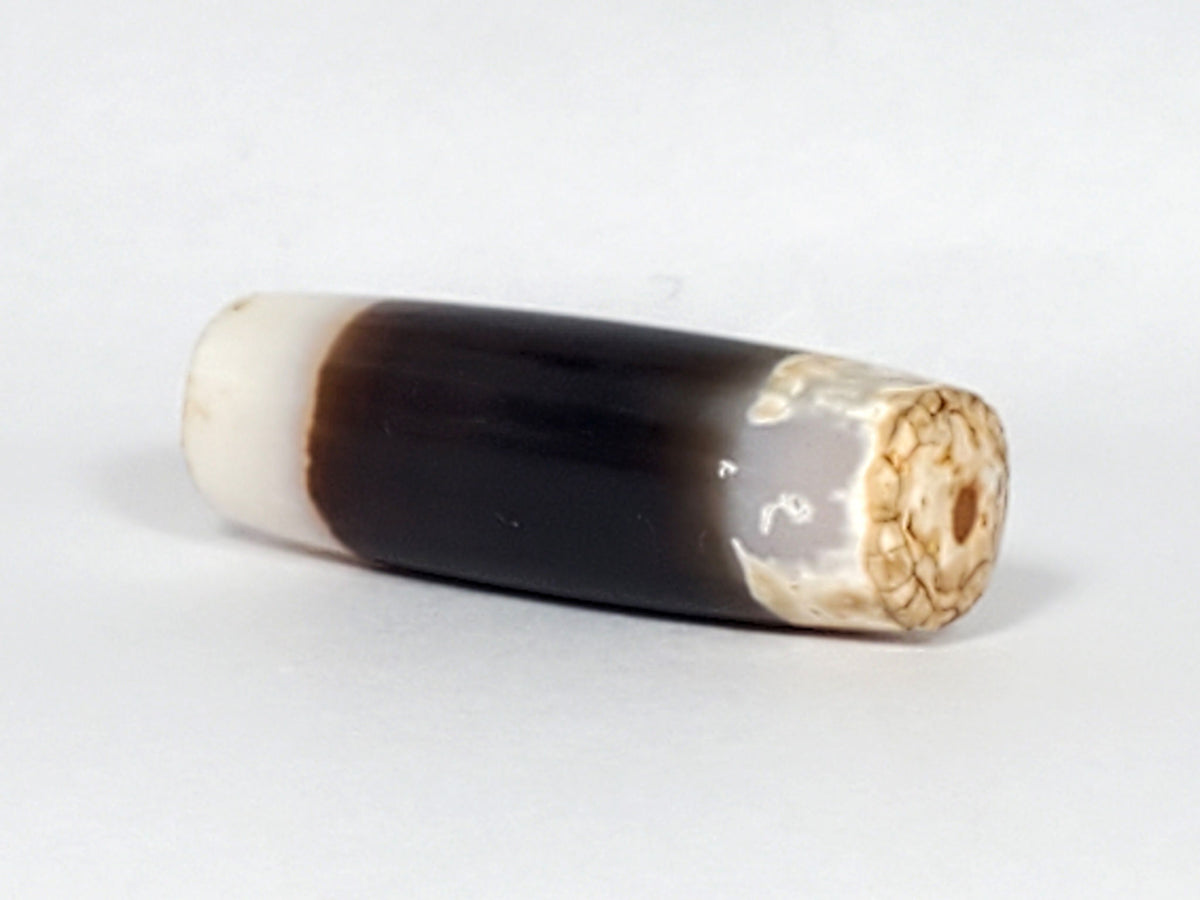
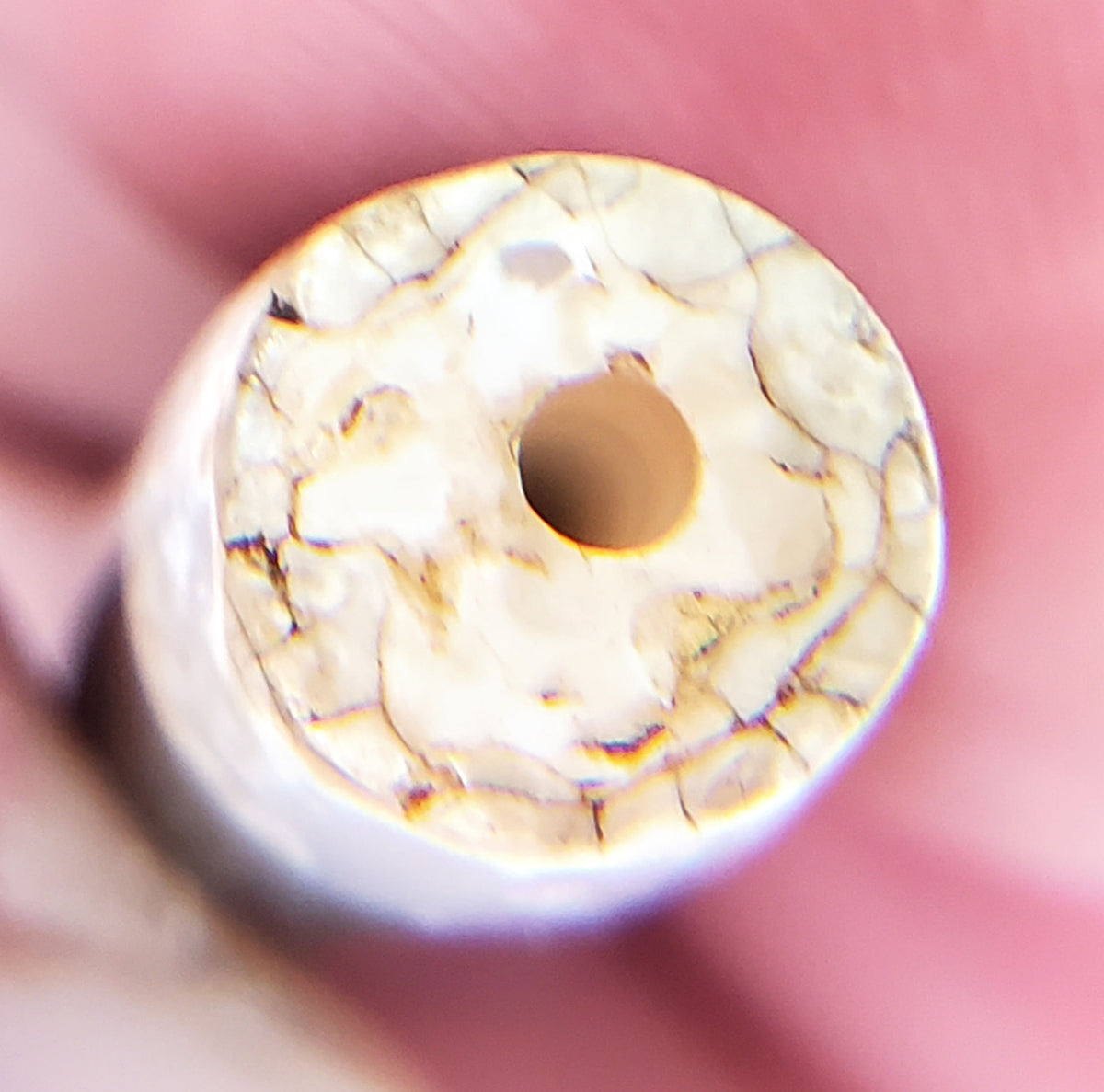
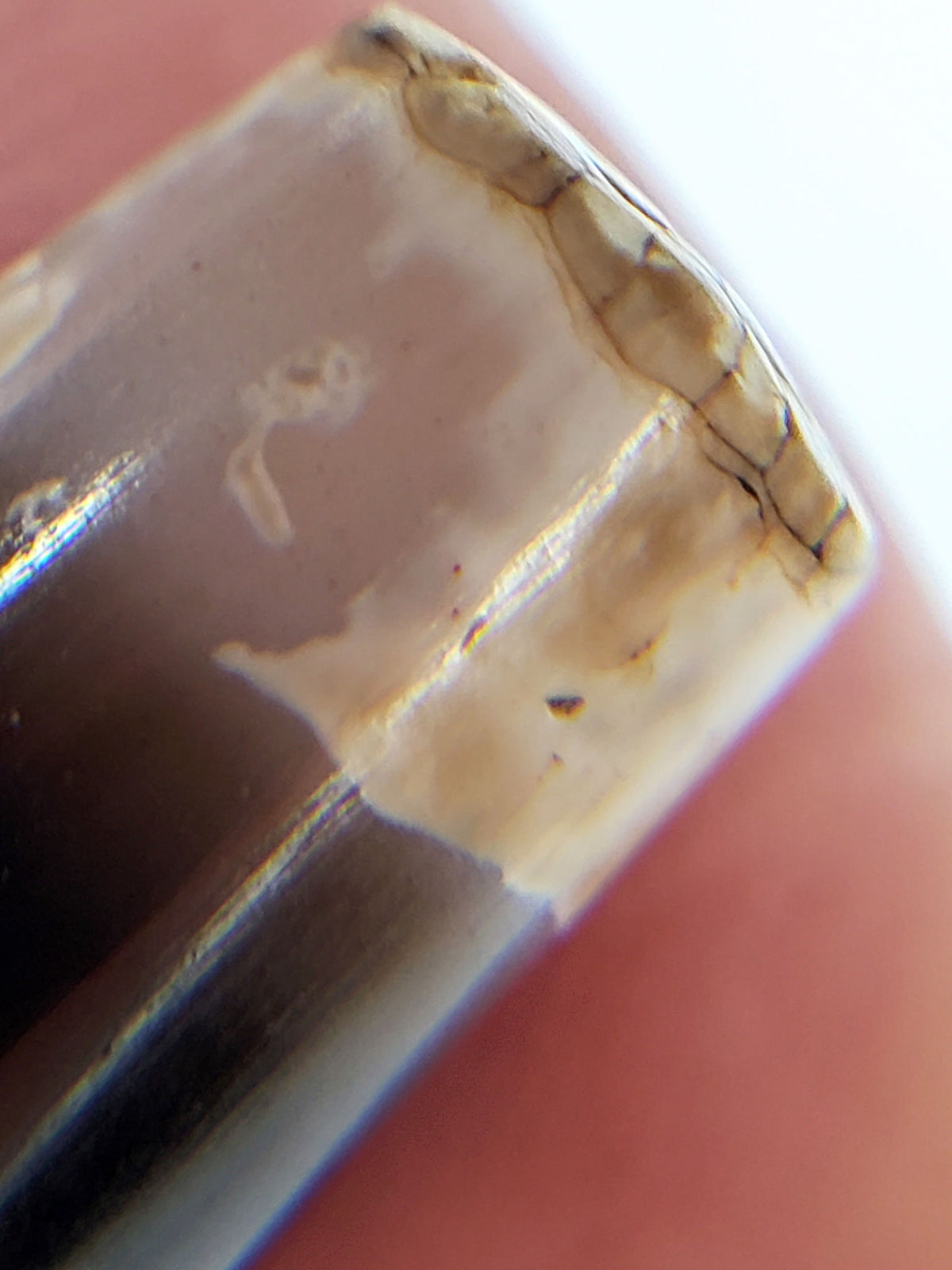
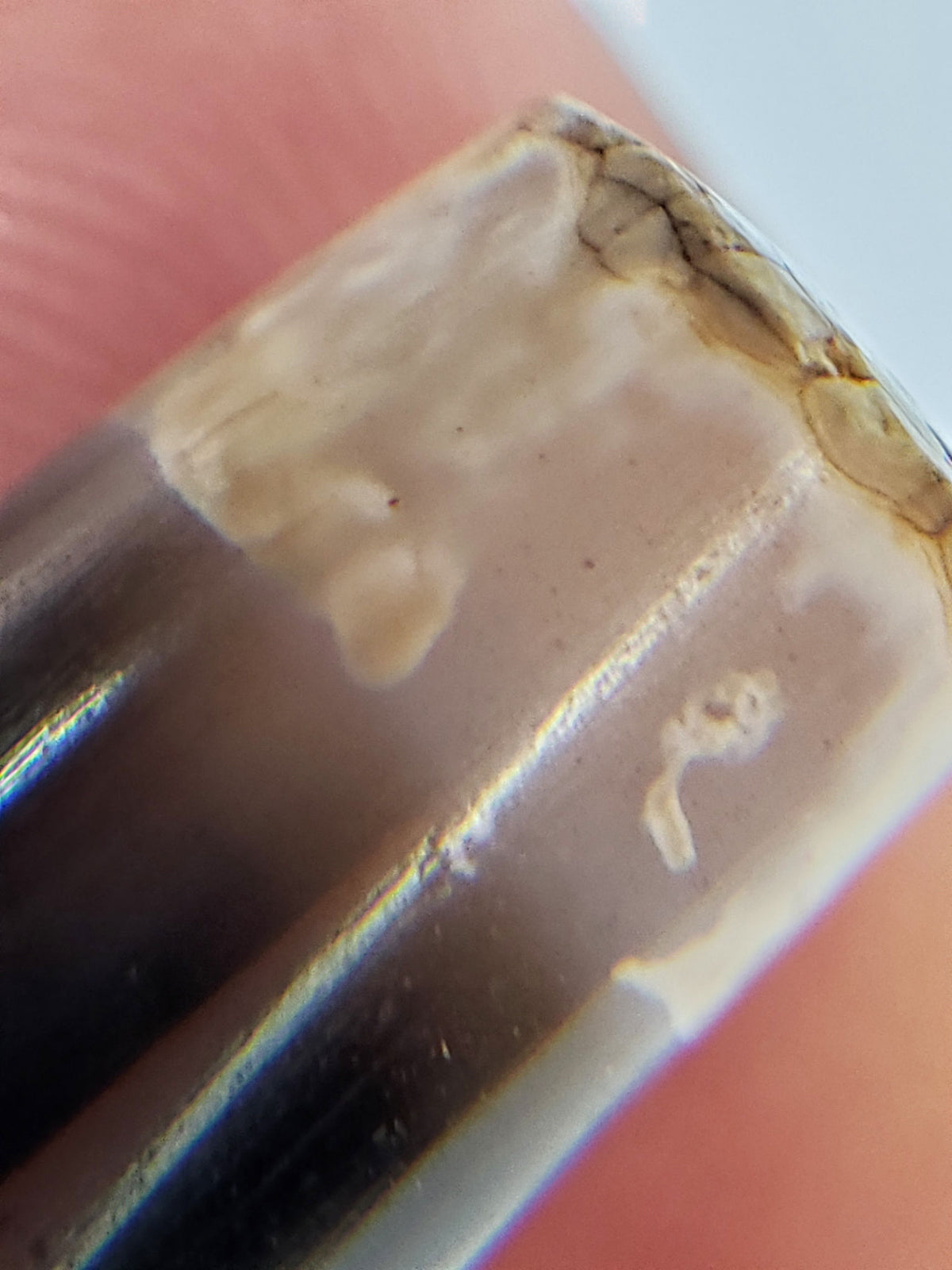
The left end cap is bright white, smooth, polished, intact — the original agate surface preserved as it has been for fifteen hundred years or more. The right end cap carries the opposite history: a deep mosaic calcification, the calcite mineral growth that accumulates on agate surfaces over extreme timescales, cracked into a tortoiseshell network of raised cream-white deposits that covers the entire right face and end cap zone. Both ends are documented fully in Images 2–4 and 9–10 respectively, and both are what they appear to be — one end preserved, one end transformed by time.
Within the calcification zone on the right end, something else is visible. In the macro photographs (Images 2 and 3), small reddish-brown circular inclusions sit within the cream zone near the boundary with the dark body: these are cinnabar bloodspot inclusions — discrete individual dots of mercuric sulfide (硃砂 / zhūshā, HgS) within the agate matrix. Cinnabar is a naturally occurring mineral that forms as red to reddish-brown crystalline dots within agate during geological formation, and its presence within dzi beads is considered an authentication marker by collectors and specialists. The bloodspot dots visible in these macro photographs sit at or near the surface of the agate within the calcification zone, several clearly identifiable as discrete circular marks of warm vermilion to reddish-brown.
The central body of this bead is pitch-black — confirmed from white-background photography (Images 5–8) as the deepest, most saturated black in the collection, without warm-brown undertone. It is high-gloss and polished across the full circumference. The single-stripe Chung dzi composition reads here as one extended dark central band occupying the majority of the bead's length, flanked by the bright white left cap and the calcified right cap. The transition from white to black on the left side is a soft, gradual gradient visible most clearly in Image 7; the transition from black to the calcification zone on the right has a different character — the calcification overlay alters the visual boundary.
The body form is a short wide barrel — not the fusiform taper characteristic of other dzi in this collection, including the antique single-stripe Chung dzi (At-020726-Chung). This bead's sides are nearly parallel, its ends flat-faced, its cross-section uniformly circular from end to end. At 31.4mm × 9.6mm it is compact and dense, with a solidity in the hand that the longer, tapered beads do not share. This barrel form at this age category is a distinctive ancient type and differentiates this bead from every other Chung dzi in the collection in both form and age.
The drill holes at both ends are age-consistent. The right end drill hole is embedded within the calcification (Image 4) and remains functional and centred despite the mineral accumulation around it. The left end drill hole (Image 10) shows a warm yellowish-tan interior passage — characteristic of ancient drill channels where centuries of exposure have changed the surface colour of the agate within the hole.
Bloodspots — Cinnabar Inclusions (硃砂 / Zhūshā)
Cinnabar (硃砂 / zhūshā) is mercuric sulfide — a naturally occurring mineral that forms as reddish crystalline inclusions within agate during geological processes. In Tibetan and Himalayan dzi bead tradition, the presence of cinnabar bloodspot dots within a bead is understood as a mark of authenticity and accumulated energy: the stone carrying its own internal vitality, visible to those who look closely. Cinnabar dots range in colour from vivid vermilion to warm rust-orange and deep reddish-brown depending on the mineral concentration, age, and stone host. In this bead they appear as warm reddish-brown discrete dots within the cream-white zone near the right end cap, visible in macro photography as individual circular marks that sit within the stone rather than on its surface. Calcification at the right end has in some areas partially exposed or framed these inclusions, making them visible in the photographs in a way that would not be possible on an unweathered surface.
The Single Stripe Chung Dzi (一條瓊珠 / Yī Tiáo Qióng Zhū)
The Chung dzi (瓊珠) is the striped category of the dzi tradition — the horizontal band bead whose dark-treated body against untreated white end zones produces the stripe effect. At its most concentrated, one dark band flanked by two white zones is the simplest possible Chung composition: a single statement, undivided, held between two clear ends. In Tibetan tradition, the single stripe carries the unbroken meaning of the continuous line — success that does not pause, a path that holds its direction from beginning to end. At 1,500–2,000 years, this is among the oldest single-stripe Chung dzi in the collection and in most private collections. The calcification at the right end is not damage — it is the surface record of those years, the stone's own documentation of the time it has occupied.
Specifications
Motif: Single Stripe Chung Dzi (一條瓊珠 / Yī Tiáo Qióng Zhū); pitch-black central body band; bright white left end cap; calcified cream-white right end cap with mosaic mineral deposits; cinnabar bloodspot inclusions (reddish-brown dots) within right end cap zone
Length: 31.4mm
Diameter: 9.6mm
Form: Short wide barrel; near-parallel sides; flat end faces; uniform circular cross-section throughout
Material: Natural agate — pitch-black central body; bright white left end cap; right end cap with extensive mosaic calcification (cream-white to sandy-tan calcite deposits); cinnabar (硃砂) bloodspot inclusions within right cap zone; warm yellowish-tan ancient drill channel interiors
Age Estimate: 1,500–2,000 years
Condition: Extensive mosaic calcification on right end cap — mineral deposit fully documented in Images 2, 3, 4, and 9; drill hole at right end intact and functional within calcification; minor surface mark on left end cap near drill hole (Image 8); no structural cracks; no rework; no medicine digs; left end cap and body fully intact
Bloodspots: Yes — discrete circular cinnabar (硃砂 / zhūshā) inclusions visible in macro photography within right end cap cream zone; warm reddish-brown individual dots; surface-visible and sub-surface within calcification zone (Images 2 and 3)
Product ID: Ac-061426-1SChungBS
Collection: Ancient Dzi Beads | Antique Dzi Beads
You may also like
- Antique Single Stripe Chung Dzi (At-020726-Chung) — single stripe Chung dzi, natural bicolour agate, no etching, ~500 years, fusiform form, 38.2×11.5mm
- Ancient Seven Stripe Chung Dzi Dark Brown Agate Scratches — seven stripe Chung dzi, near-pitch-black ground, 1,000–1,500 years, 49.4×11.9mm
- Ancient Seven Stripe Chung Dzi Bloodspots Odd Form — seven stripe Chung dzi, warm honey-brown ground, 1,000–1,500 years, 49.1×12.8mm
- Ancient Seven Stripe Chung Dzi Bloodspots Odd Form — seven stripe Chung dzi, warm dark brown ground, two surface scratches, 1,000–1,500 years, 48.2×12.4mm
- Antique Wave Stripe Dzi Bead — cinnabar bloodspots in agate dzi tradition, different motif comparison
From the blog
- What Makes a Dzi Bead Authentic? — on reading calcification, ancient drill holes, and surface age markers in the most ancient dzi beads
- The Meaning of the Stripe Motif in Dzi Tradition — on the Chung dzi, stripe count, and the single-stripe composition in Tibetan protective beads
One stripe. One end preserved. One end transformed by fifteen hundred years of time. Both photographed exactly as they are.
We never retouch our photos. What you see is exactly what you will receive.
📷 We never retouch our photos. Every bead is photographed exactly as it is. What you see is what you receive.
Hashtags
#AncientDziShop #AncientDziBead #SingleStripeChungDzi #ChungDzi #瓊珠 #YiTiaoQiongZhu #BloodspotDzi #CinnabarDzi #硃砂 #TibetanDziBead #HimalayanBead #AncientBead #TibetanJewelry #Ac0614261SChungBS #CalcifiedDzi
Couldn't load pickup availability