Summer Sale! Enjoy 30% Discount At Checkout


Ancient Dzi Shop
Tiger Tooth & Stripe Carnelian Dzi, 49.8 × 12.7mm, tri-tone dark ground (At-040524-TTStr)
Tiger Tooth & Stripe Carnelian Dzi, 49.8 × 12.7mm, tri-tone dark ground (At-040524-TTStr)
We never retouch our photos. What you see is exactly what you will receive.
The ground of this bead is not one colour — and that changes everything about how the motif reads.
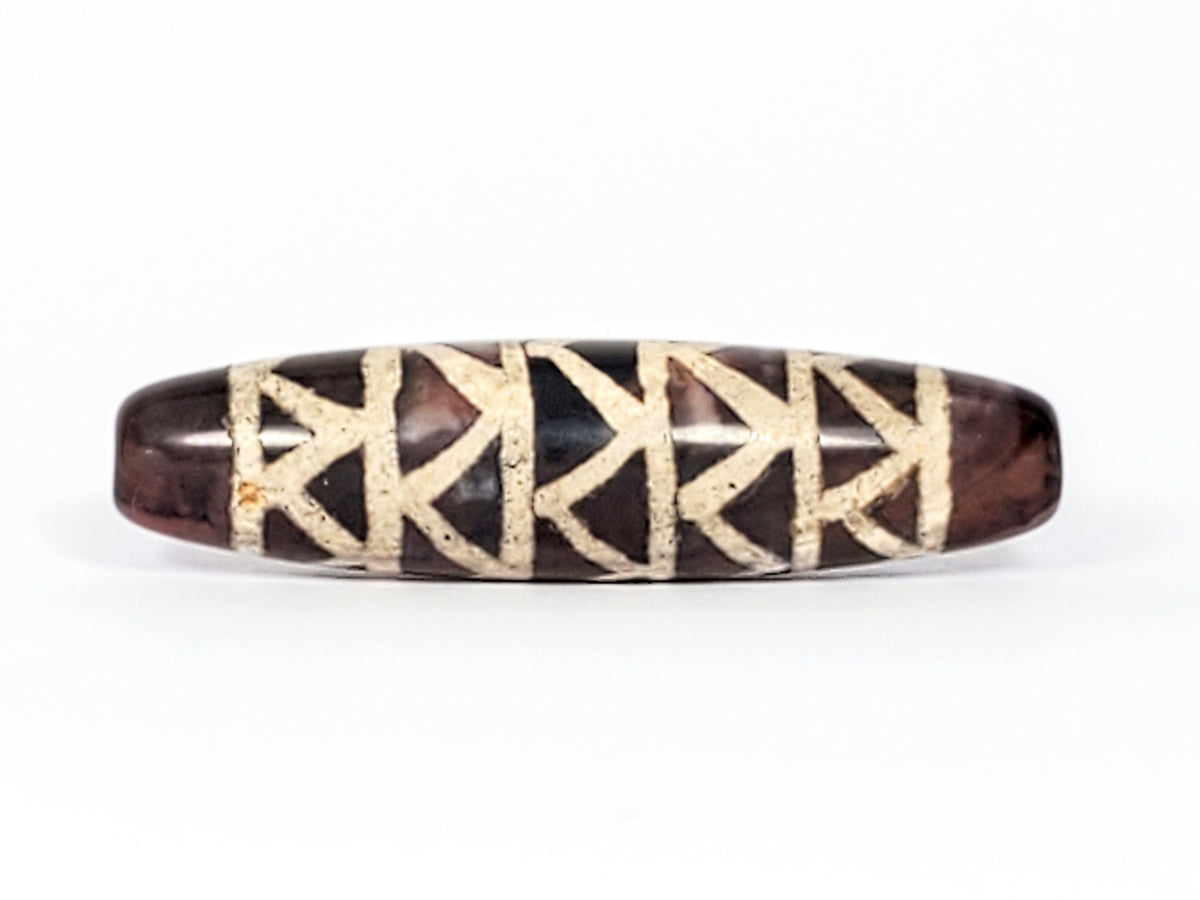
Most carnelian dzi in this collection carry a consistent ground tone from end to end. This bead does not. The natural carnelian from which it was formed contains three distinct colour zones: warm reddish-brown end caps that taper to rounded points, deep dark chocolate-brown flanking the central body, and a band of pitch-black natural agate banding at the core — visible clearly from white-background photographs in the negative spaces between the etched tooth forms. The cream-white acid-etched motif runs across all three zones simultaneously, and its character shifts as the ground beneath it changes. Against the pitch-black central banding, the cream-white lines read at maximum contrast. Against the warmer reddish-brown of the end cap transitions, they soften. Against the dark chocolate-brown, they occupy the middle register between those two readings. The motif does not change — the stone changes beneath it.
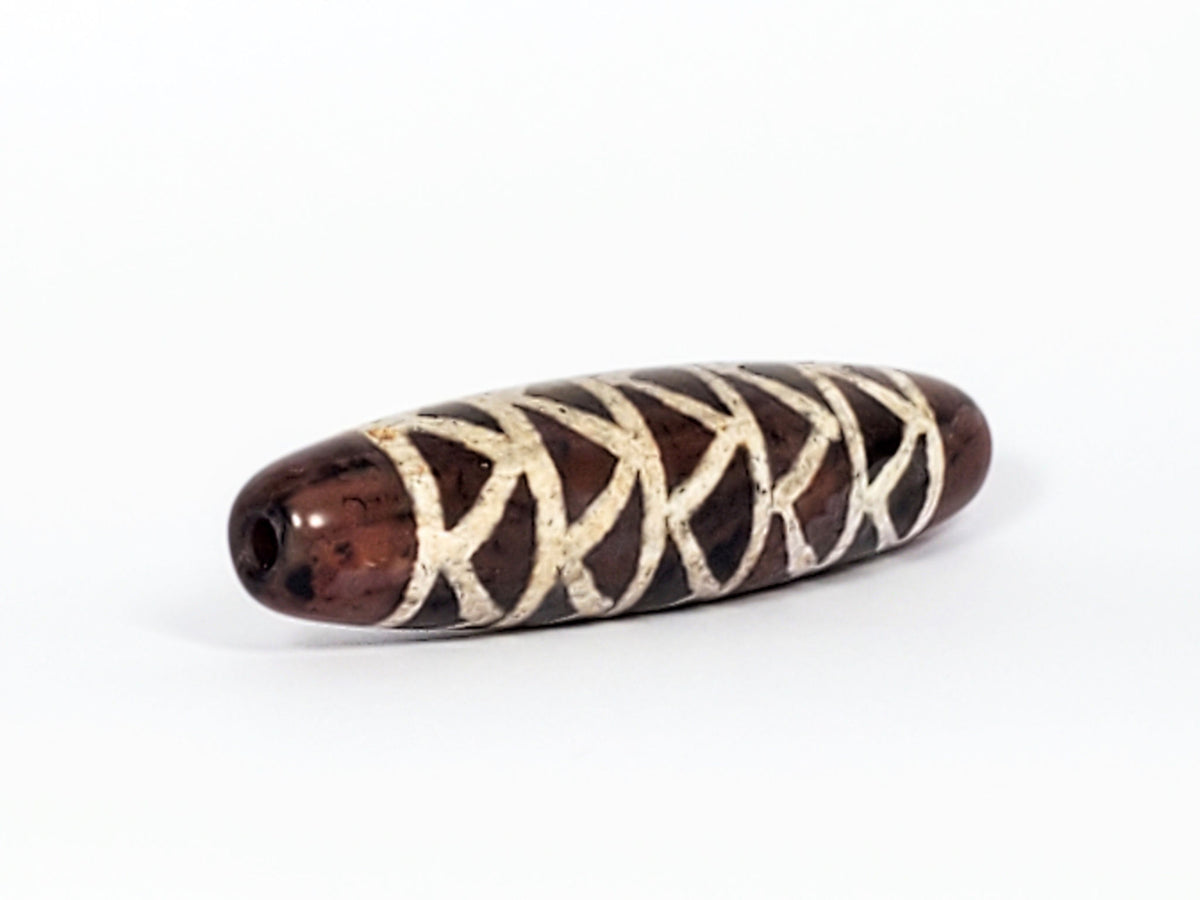
The composition itself is among the densest in the antique carnelian collection. Five registers of paired tiger tooth chevrons alternate with six vertical stripe dividers across the full circumference, creating a continuous interlocking pattern that covers the entire motif field from end cap boundary to end cap boundary without a gap. Each tooth register consists of a mirrored pair: upper arrowheads pointing downward, lower arrowheads pointing upward, their tips nearly meeting at the centre of the register. The vertical stripe dividers — clean, straight etched lines running the full height of the motif band — give the composition its rhythm and prevent the tooth forms from merging into a single undifferentiated field. At the density visible in Images 2 and 4, the overall visual impression at normal viewing distance is of a bead almost entirely covered in cream-white etching, with the dark ground reading as negative space between the lines rather than as the dominant surface.
The three faces are not identical. Face A (Image 2) shows the fullest contrast: the pitch-black body banding is most prominently visible in the central registers, and the cream-white lines are bold and well-preserved. Face B (Image 3) shows the same composition with slightly softer etching — the lines are marginally thinner in some registers, consistent with contact wear on the reverse face of an amulet bead. Face C (Image 4) is the boldest in terms of line preservation and shows the most consistently cream-white mineralisation across all registers.
The end cap views (Images 5 and 6) confirm two details worth noting. First, the drill holes are small, clean, and centred — not funnel-type, consistent with the age category. Second, the end caps show natural carnelian veining and flow marks within the stone — this is not surface damage but the internal structure of the material, visible here because the end cap zones were not etched and the natural translucency of the stone allows the interior pattern to show through.
This bead is explicitly different from the Three Eye & Tiger Stripe carnelian (At-071322-3ETT) also in the collection. That bead is larger (52.4×15.1mm), carries large open V-chevrons anchored by three diamond eyes, and has a uniform dark ground. This bead is smaller in diameter (12.7mm versus 15.1mm), has no eye element, features a denser repeating tooth-pair composition with vertical stripe dividers, and carries a genuinely tri-tonal ground that no other carnelian in the collection replicates.
The Tiger Tooth & Stripe (虎牙條紋 / Hǔyá Tiáowén) Motif
The tiger tooth (虎牙) in the Tibetan dzi tradition carries the direct energy of the mountain predator: strength, decisiveness, the authority of a presence that does not need to announce itself. Where the eye motif deflects and watches, the tooth acts. In a bead where the tiger tooth appears not once but in repeating paired registers — five rows, each pair mirroring the next — the accumulated effect is understood as an amplification of that energy: not a single tooth but a full set, directed outward in all directions simultaneously. The stripe dividers (條紋 / tiáowén) between each register have their own meaning: continuity, the unbroken line, the path that does not end. In combination, tiger tooth and stripe produce a motif that carries both the force of the predator and the persistence of a line that simply does not stop — two qualities that made this bead type valued by Himalayan traders, warriors, and practitioners for whom protection on the road was not metaphorical.
Specifications
Motif: Tiger Tooth & Stripe (虎牙條紋 / Hǔyá Tiáowén); five registers of paired interlocking tiger tooth chevrons; six vertical stripe dividers; full circumference coverage
Length: 49.8mm
Diameter: 12.7mm
Form: Elongated fusiform; rounded pointed end caps; widest at centre; symmetrical bilateral taper
Material: Natural tri-tone carnelian — pitch-black central body banding; deep dark chocolate-brown body ground; warm reddish-brown end caps; cream-white acid-etched motif lines throughout
Age Estimate: 200–500 years
Condition: Face B shows minor line softening consistent with contact wear (disclosed, Image 3); minor natural surface pitting on end caps (not damage); no cracks; no rework; no medicine digs; drill holes clean and centred
Bloodspots: None observed
Product ID: At-040524-TTStr
Collection: Antique Tortoise Shell Motif Carnelian Dzi | Antique Two Eye Motif Dzi Bead With Rare Bloodspots
Related Tiger Tooth & Stripe Motifs
Tiger tooth and stripe compositions span centuries of Himalayan protection practice. These related examples showcase variations in density, ground tone, and eye integration that complement this tri-tone carnelian.
Antique
Antique beads in this collection share the same 100–500 year age range and demonstrate refinement of composition across dark agate grounds.
- Three Eye Tiger Stripe Carnelian Dzi, 52.4×15.1mm, dark chocolate-brown with diamond eyes and V-chevrons (At-071322-3ETT) — $1000.00
- Four Eye & Tiger Tooth Dzi Bead, 49.0×11.7mm, very dark brown agate (At-071026-4ETT) — $800.00
- Three Eye & Tiger Tooth Dzi, 46.2×12.9mm, pitch-black agate (At-061926-3ETT) — $3500.00
- Antique Six Tiger Stripe Carnelian Dzi, 50.7×12.9mm, chocolate-brown with bicolour end caps (At-070822-6TS) — $1500.00
- Three Diamond Eye & Tiger Tooth Dzi, 40.1×13.9mm, pitch-black agate, 200–300 years (At-090126-3DETT) — $3000.00
- Antique Six Eye & Tiger Tooth Dzi, 57.9×12.9mm, diamond-framed eyes with honey-gold motif (At-053126-6ETT) — $3000.00
New & Vintage
Contemporary and 1980s Taiwan examples that explore tiger tooth themes without etching density or historical ground complexity.
- New Tiger Tooth & Six Eye Lotus Dzi Bead, 25.1×19.6mm, cream-ground dark brown barrel (N-062226-TTSEL) — $300.00
- Vintage Six Eye & Tiger Tooth Dzi with Extreme Bloodspots, 49.1×12.3mm, cinnabar-saturated sandy-peach field (V-061026-6ETTBS) — $600.00
- Tiger Tooth Motif Pair, 20.3×14.7mm & 20.5×14.7mm, warm terracotta agate with bloodspots (At-062926-TTBS) — $600.00
- Tiger Tooth Motif Pair, 21.9×17.2mm & 20.7×17.2mm, brown-ground agate with bloodspots (N-062926-TTBS2) — $300.00
- Tiger Tooth Motif, 22.1×18.3mm, cream-white and brown agate (V-062926-TT) — $600.00
From the blog
- Ancient Two Eye Motif Dzi Bead Extremely Old — on acid-etching, surface mineralisation, and reading age in carnelian dzi
- Ancient Six Eye Lotus Motif Carnelian Dzi — on the role of natural stone colour variation in Himalayan protective jewellery
Five rows of teeth. Six dividing stripes. One stone that decided to be three colours at once.
We never retouch our photos. What you see is exactly what you will receive.
📷 We never retouch our photos. Every bead is photographed exactly as it is. What you see is what you receive.
Hashtags
#AncientDziShop #AntiqueCarneliaDzi #TigerToothDzi #TigerStripeDzi #HuYaTiaoWen #CarneliaDzi #TibetanDziBead #HimalayanBead #TriToneCarnelian #DziBead #AntiqueBead #TibetanJewelry #At040524TTStr #ProtectiveBead #CarnelianAmulet
Couldn't load pickup availability