Summer Sale! Enjoy 30% Discount At Checkout


Ancient Dzi Shop
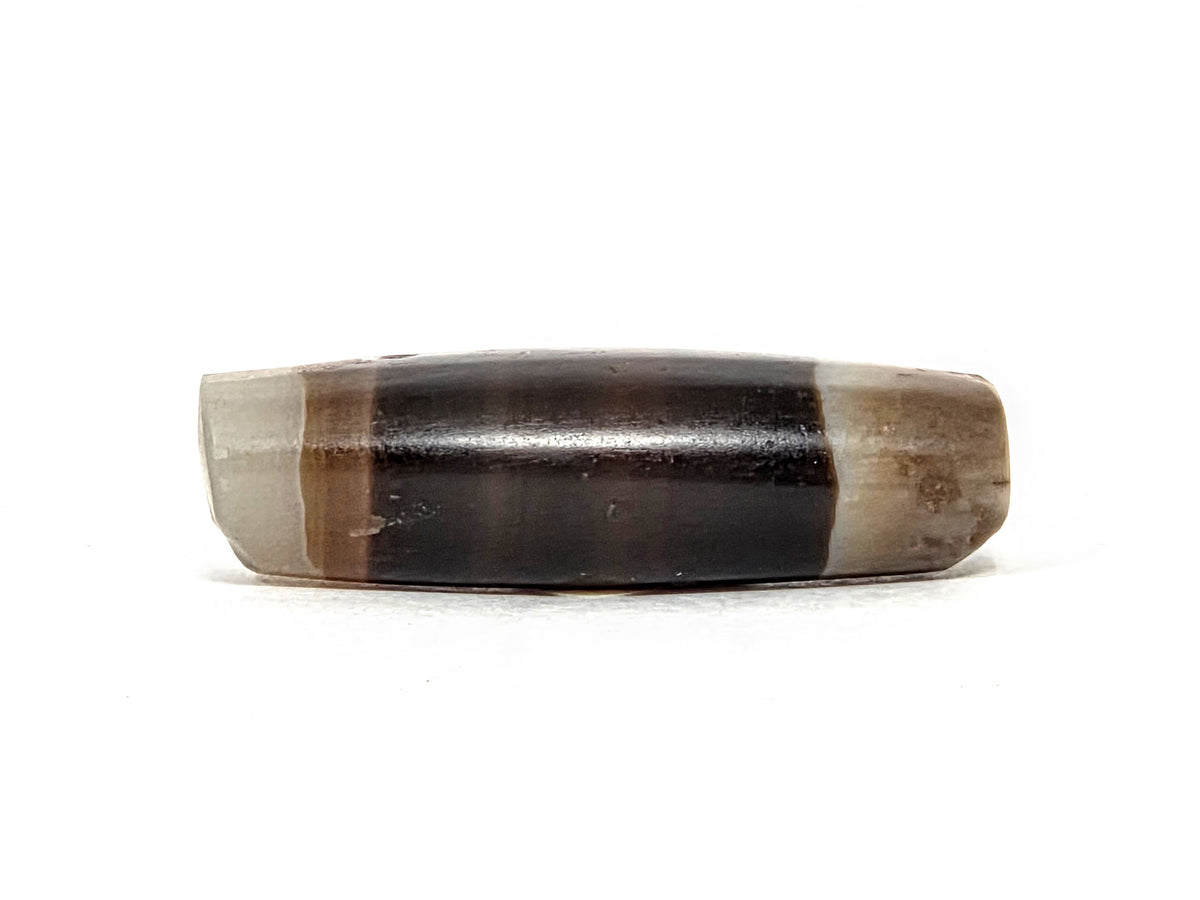
Ancient Single Stripe Chung Dzi 黑白珠, 26.3×9.7×7.8mm, belly form, medicine-chipped ends (Ac-061526-1SBW)
Ancient Single Stripe Chung Dzi 黑白珠, 26.3×9.7×7.8mm, belly form, medicine-chipped ends (Ac-061526-1SBW)
We never retouch our photos. What you see is exactly what you will receive.
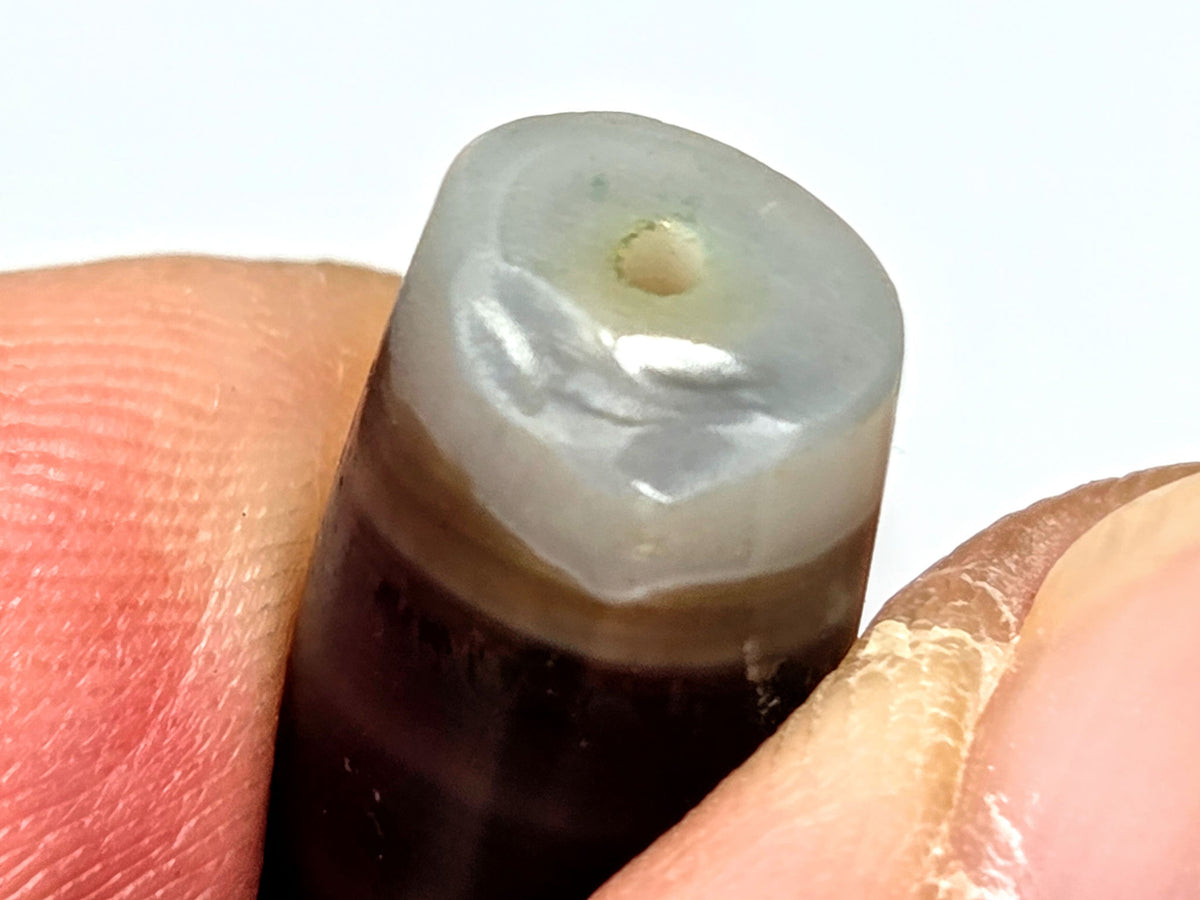
At both drill hole openings of this bead, the agate has turned blue-green — and the ring it left behind is exactly the size of the cord that passed through it for a thousand years.
The blue-green mineral deposit visible in Images 3, 4, 11, and 12 forms a precise ring around each drill hole opening — not a broad crust covering the end cap, but a localised circle sitting exactly at the boundary between the stone and wherever the stringing cord made long-term contact. It is copper-bearing mineral chemistry, deposited through centuries of burial and wear in environments where copper compounds were present — prayer beads strung with copper-alloy components, buried in copper-rich soil, or both. It is not applied. It is not decorative. It is a record of use, and it is irreproducible. The same burial chemistry marker appears on Ac-080420-19SChung (Ancient Nineteen Stripe Pair), but on those beads it formed as a broad crust; here, on this much smaller bead, it has formed as a precise ring — the exact circumference of a cord that has not been there for a very long time.
The end caps of this bead carry a different kind of history. Both end cap faces show percussive damage — multiple irregular impact sites, concave breaks, and chipped surface areas consistent with deliberate extraction of agate material for use in traditional Tibetan medicine practice. In Tibetan medical tradition, material from ancient and sacred beads — particularly highly charged pieces believed to have accumulated spiritual potency through centuries of use — was sometimes carefully removed and ground into medicine preparations. The resulting damage to the end cap faces is not accidental impact: it is the product of deliberate, repeated percussion, creating the irregular multi-break surfaces visible clearly in Images 2, 3, 4, 11, and 12. A bead that has been used for medicine digs has been trusted twice — once as a worn object, once as a healing one. The damage is not a deduction from its significance; in traditional Tibetan collecting, it is an addition.
This bead is known in Chinese collecting tradition as a 黑白珠 (hēi bái zhū — black-white bead): a natural bicolour agate in which the stone itself produces a dark central zone flanked by pale end caps, with no etching applied. The dark central zone is a deep dark grey-brown to near-pitch-black with warm purple-brown internal colour variation — rich and complex, not flat. The end caps are cool milky pale grey-white to pale grey-green, translucent and luminous, with warm honey-brown gradient transition zones between the pale ends and the dark body on each side. This three-zone colour architecture — pale cap / warm gradient / dark centre / warm gradient / pale cap — is the stone's own, laid down during geological formation and preserved through a thousand years or more of existence.
The body form is a short wide belly shape — the bead bulges outward at its mid-point and tapers toward both ends, with the cross-section measuring 9.7mm at widest and 7.8mm at narrowest, confirming it is not round. The surface across all zones is high-gloss, and fine micro-scoring lines across the dark body surface are visible in the lateral photographs — consistent with centuries of handling wear. The drill holes at both ends are small with the blue-green burial mineral ring surrounding each opening.
No etching was applied to this bead. This places it in the same natural colour-zone category as At-020726-Chung (Antique Single Stripe Chung Dzi) — but that bead is antique (~500 years), fusiform, bicolour only, and carries no burial mineral deposits or medicine dig damage. This bead is ancient (1,000–1,500 years), belly-form, trizone in colour architecture, and carries blue-green burial chemistry at both drill holes alongside clear evidence of traditional medicine use at both ends. Also related but distinct: Ac-061526-1SPair (Ancient Single Stripe Bicone Pair) carries calcification deposit stripes on bicone-form beads — a completely different surface mechanism, form, and composition.
The Black-White Bead — 黑白珠
The 黑白珠 (hēi bái zhū) is recognised in Tibetan and Chinese collecting traditions as among the most fundamental expressions of natural agate duality: darkness held between two pale ends, or light framed by dark — depending on which reading you bring to it. In Tibetan cosmology the opposition of dark and pale is not a conflict but a completion: the two poles define each other, and what sits between them is the axis. On this bead the dark body is the axis and the pale end caps are the poles — and the cord that once passed through both holes held all three zones together on a single thread. The single stripe (一線紋) in this context is not a decorative band added to the stone but the stone's own decision about what to be: a bead that the agate made before the craftsman found it.
Motif: Single stripe (一線紋), natural bicolour; 黑白珠 (hēi bái zhū — black-white bead); deep dark grey-brown to near-pitch-black natural agate central zone with warm purple-brown internal variation; warm honey-brown gradient transition zones; cool milky pale grey-white to pale grey-green translucent end caps; no etching applied
Length: 26.3mm
Diameter: 9.7mm (widest) × 7.8mm (cross-section depth — non-round confirmed)
Form: Short wide belly form — outward belly at mid-body tapering to both ends; non-round cross-section; both end cap faces show deliberate percussive damage consistent with traditional Tibetan medicine dig use
Material: Natural bicolour agate; high-gloss surface across all zones; fine micro-scoring on dark body surface (age-consistent)
Age Estimate: 1,000–1,500 years
Condition: Both end cap faces carry deliberate percussive damage consistent with traditional Tibetan medicine dig extraction (disclosed, Images 2, 3, 4, 11, 12); most prominent damage on right end cap upper area; fine surface crack line on left end cap face (disclosed, Image 12); fine age-consistent micro-scoring on dark body; blue-green mineral burial deposit ring at both drill hole openings (authentication marker, disclosed, Images 3, 4, 11, 12)
Bloodspots: None
Product ID: Ac-061526-1SBW
Collection: Ancient Seven Stripe Chung Dzi Agate Near Pitch Black | Ancient Dzi Beads
Related Chung Dzi & Striped Agate Beads
Stripe-form and single-colour-zone beads that share the natural bicolour and medicine-marked heritage of this bead:
Ancient
The finest examples carry burial chemistry and undisturbed age patina across over 1,000 years:
- Ancient Nineteen Stripe Chung Dzi Pair, 46.4×11.8mm & 46.9×11.6mm, blue-green burial deposits, over 1,500 years — Ac-080420-19SChung — $4000.00
- Ancient Seven Stripe Chung Dzi, 49.4×11.9mm, near-pitch-black ground, 1,000–1,500 years — Ac-081020-7SChung — $5000.00
- Ancient Five Stripe Cho Dzi (Cuosi), 57.5×13.1mm, milky translucent grey-white & pitch-black bands — Ac-061426-5SChung — $8000.00
- Ancient Single Stripe Chung Dzi Bicone Pair, 25.4×9.2mm & 25.2×9.4mm, pale and dark bicone form — Ac-061526-1SPair — $3500.00
Antique
Striped and single-zone beads from the 100–500 year range, many with medicine dig evidence or natural color transition:
- Antique Single Stripe Bow-Shaped Chung Dzi, 38.1×11.5×8.9mm, tricolour natural agate — At-061526-1SBow — $700.00
- Antique Nine Stripe Chung Dzi with Bloodspots, 44.7×11.6mm, pitch-black ground — At-110223-9SBS — $1700.00
- Antique Nine Stripe Chung Dzi Pair, 30.1×9.9mm & 30.2×9.5mm, agate — At-062626-9SChung — $1500.00
- Antique Five Stripe Chung Dzi, 48.2×13.1mm, warm terracotta reddish-brown — At-070622-5SChung — $1500.00
New & Vintage
Modern and 1980s Taiwan-made stripe and natural-agate interpretations for learning and completion:
From the blog:
The cord is gone. The ring it left behind is still there.
We never retouch our photos. What you see is exactly what you will receive.
📷 We never retouch our photos. Every bead is photographed exactly as it is. What you see is what you receive.
#AncientChungDzi #HeiBaiZhu #黑白珠 #SingleStripeDzi #AncientDziBead #TibetanDzi #MedicineDig #TibetanMedicine #BurialMineralDeposit #AncientDziShop #Ac061526-1SBW #BellyFormDzi #BicolourAgate #NaturalAgateDzi #TibetanBuddhistBead
Couldn't load pickup availability