Summer Sale! Enjoy 30% Discount At Checkout


Ancient Dzi Shop
Nine Eye Dzi with Cinnabar Bloodspots, 41.3×14.5mm, Pitch-Black Agate (At-061926-9E6BS)
Nine Eye Dzi with Cinnabar Bloodspots, 41.3×14.5mm, Pitch-Black Agate (At-061926-9E6BS)
We never retouch our photos. What you see is exactly what you will receive.
The bloodspots on this bead appear in two different places, and they look completely different in each one.
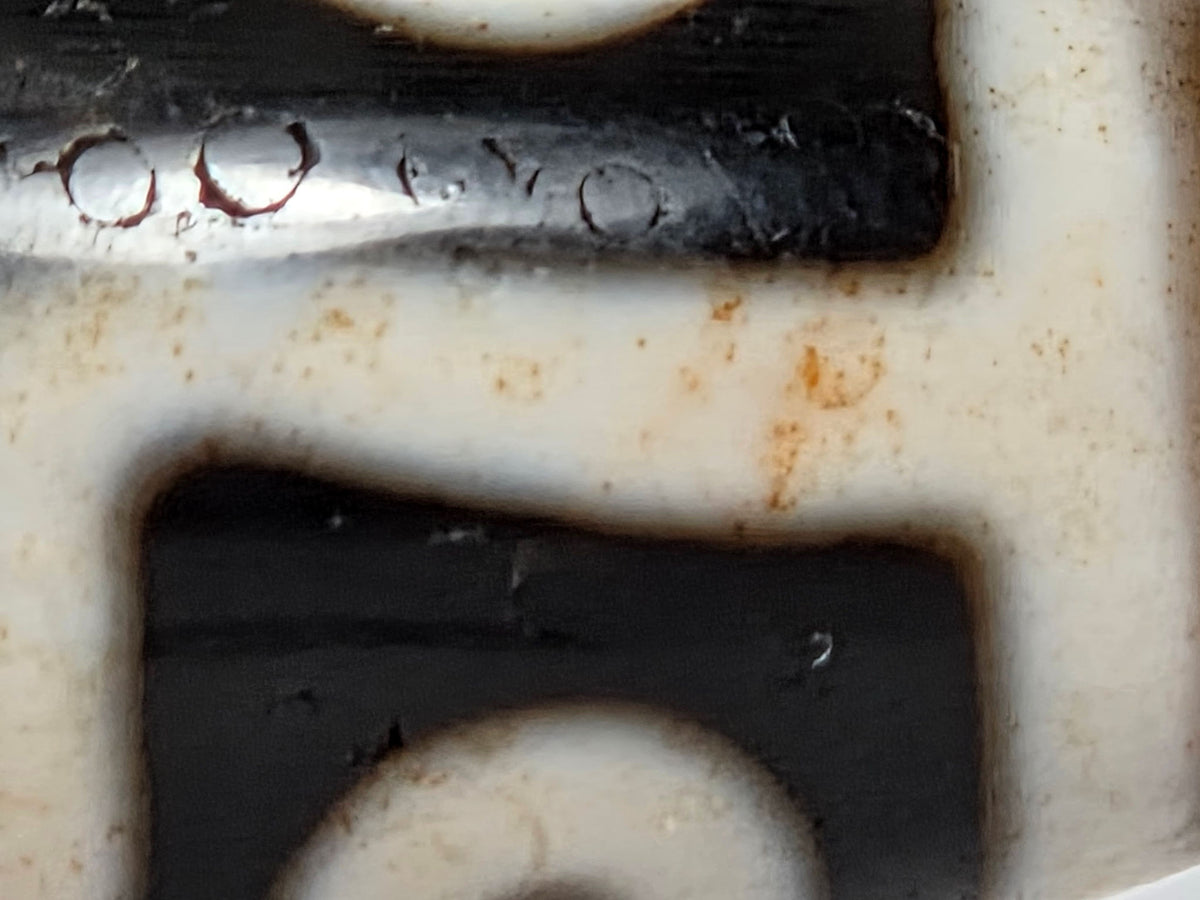
In the cream-white zones — the eye rings and connector bands — the cinnabar reads as warm rust-orange to terracotta-orange micro-speckles, scattered across the surface and just beneath it, visible to the naked eye and confirmed in the first macro photograph (Image 6). In the pitch-black ground zones, the same mineral takes a different form: in the second macro photograph (Image 7), small dark red-brown halos are visible within the black, inclusions pressing through from inside the stone rather than sitting on its surface. One mineral, two visual languages, one bead. That compound presentation has not appeared in any other nine-eye dzi in this collection.
The nine eyes are distributed five per lateral face — three in the upper register, two in the lower — connected by a continuous stepped S-meander running through the composition in angular, right-angled turns. Each eye is a fully closed concentric ring: bold cream-white outer ring, pitch-black interior, warm dark brown pupil at the centre. The meander connector between and around them is not a smooth wave but a stepped, angular line that reads almost architectural — a grid of right angles carrying the eye count across the face. The composition on Face B (Image 2) differs slightly from Face A in its central eye's ring definition, consistent with hand-applied ancient etching that never repeats exactly.
The ground of this bead is pitch-black — confirmed across all flat-lit white-background photographs. The motif lines are bright cream-white throughout. The end caps at both tips are warm sandy-tan, distinctly lighter in tone than the pitch-black body and warmer than the cream-white etching, providing a three-tone sequence from tip to field to motif that is visible from any angle. The drill holes at both tips are small, neat, and well-centred, with warm reddish-brown interiors visible in the angled photographs.
At 41.3×14.5mm, this bead is the most compact nine-eye in the collection by length and the widest by diameter. Every other antique nine-eye in this collection measures between 53.7mm and 59.0mm in length; this one is 41.3mm — significantly shorter, significantly wider, and as a result the motif wraps more tightly across a broader surface. The nine eyes occupy more of the visible face area relative to the connector bands, which changes how the composition reads: denser, more frontal, less sequential.
The macro photographs document the bead's surface in detail. At that scale, a fine network of micro-crack weathering lines is visible within the cream-white etching zones — not structural damage, but surface weathering of the etched layer over two to three centuries, consistent with the age range and confirming that the etching and the stone have aged together. A single surface pinhole is also visible near the upper boundary of Face B (Image 2). Both are disclosed.
Differentiation note: At-011625-9E (54.0mm), At-051525-9E2 (54.9mm), At-083025-9E3 (53.7mm), and At-012325-9E4 (59.0mm) — all four antique nine-eye beads in this collection are elongated fusiform beads 12–13mm in diameter. None carries bloodspots. At-061926-9E6BS is 41.3mm long and 14.5mm wide, compact and broad in form, and carries compound cinnabar bloodspot inclusions in both its cream and black zones. It is differentiated from every other nine-eye in this collection on form, scale, and surface character simultaneously.
The Nine Eye Motif
The nine-eye motif (九眼天珠, jiǔ yǎn tiānzhū) is among the most revered forms in Tibetan dzi tradition. Nine is considered the number of completion in Tibetan Buddhist cosmology — the highest single digit, representing the full accumulation of merit and awareness across all realms. A nine-eye dzi is understood to attract good fortune, remove obstacles, and provide the wearer with the combined protective force of all nine directional guardians simultaneously.
The cinnabar inclusions (硃砂, zhūshā) — mercuric sulfide — found within this bead carry their own significance in Tibetan sacred object traditions. Cinnabar has been used in ritual contexts across Himalayan and Chinese Buddhist practice for centuries. Its presence within an ancient dzi is understood as evidence of long contact with consecrated materials and practices, and is considered by collectors to be a primary authentication marker alongside surface weathering and drill hole character.
Specs
Motif: Nine Eye (九眼天珠, jiǔ yǎn tiānzhū); five fully closed concentric ring eyes per lateral face in 3+2 upper-lower distribution; continuous stepped right-angled S-meander connector running through all eye positions; warm dark brown pupil at centre of each eye ring
Length: 41.3mm
Diameter: 14.5mm
Form: Compact oval barrel/fusiform; widest-diameter nine-eye in the collection; significantly shorter and broader than all other antique nine-eye beads
Material: Natural agate; pitch-black ground; bright cream-white motif lines; warm sandy-tan end caps; warm reddish-brown drill hole interiors
Age Estimate: 200–300 years
Condition: Semi-gloss surface with age micro-texture; fine micro-crack weathering network visible in cream-white etching zones at macro scale (age-consistent, non-structural); single surface pinhole at upper boundary of Face B disclosed; both drill holes small, neat, well-centred
Bloodspots: Yes — compound dual presentation confirmed in macro photographs: (1) warm rust-orange to terracotta-orange cinnabar (硃砂, zhūshā) micro-speckles on and just beneath surface of cream-white eye rings and connector bands (Image 6); (2) dark red-brown cinnabar halo inclusions within pitch-black ground zones, visible as circular halos pressing through the black agate (Image 7)
Product ID: At-061926-9E6BS
Collection: Antique Dzi Beads | Nine Eye Dzi
You may also like
For the other antique nine-eye beads in this collection — all elongated fusiform and without bloodspots: Antique Nine Eye Dzi Bead (54.0×12.3mm), Antique Nine Eye Dzi Bead (54.9×12.3mm), Antique Nine Eye Dzi Bead (53.7×12.1mm), and Antique Nine Eye Dzi Bead (59.0×13.2mm, deep dark ground, largest in collection).
For other bloodspot beads in the collection, see Antique Two Eye Dzi With Bloodspots (pervasive cinnabar; rose-peach tinted lines) and Ancient Dharma Conch Four Eye Dzi 52 8Mm Ac 061926 Dc4E (golden-orange sub-surface cinnabar micro-dots). For the densest cinnabar field in the collection: Antique Six Eye Tiger Tooth Dzi Bead Honey Gold.
From the blog
Antique Two Eye Dzi Cinnabar Bloodspots
Antique Nine Eye Dzi Bead Meaning and Authentication
(Owner to verify blog URLs before publishing)
Nine eyes, two kinds of bloodspot, one bead compact enough to hold in a closed fist — and old enough that the cinnabar has had two centuries to find its way through the stone.
We never retouch our photos. What you see is exactly what you will receive.
📷 We never retouch our photos. Every bead is photographed exactly as it is. What you see is what you receive.
Hashtags
#AncientDziShop #NineEyeDzi #BloodspotDzi #九眼天珠 #硃砂 #CinnabarDzi #AntiqueDzi #TibetanDzi #DziBeads #PitchBlackDzi #TibetanAntiques #DziCollection #AntiqueDziBeads #At061926-9E6BS #NaturalAgate
Couldn't load pickup availability